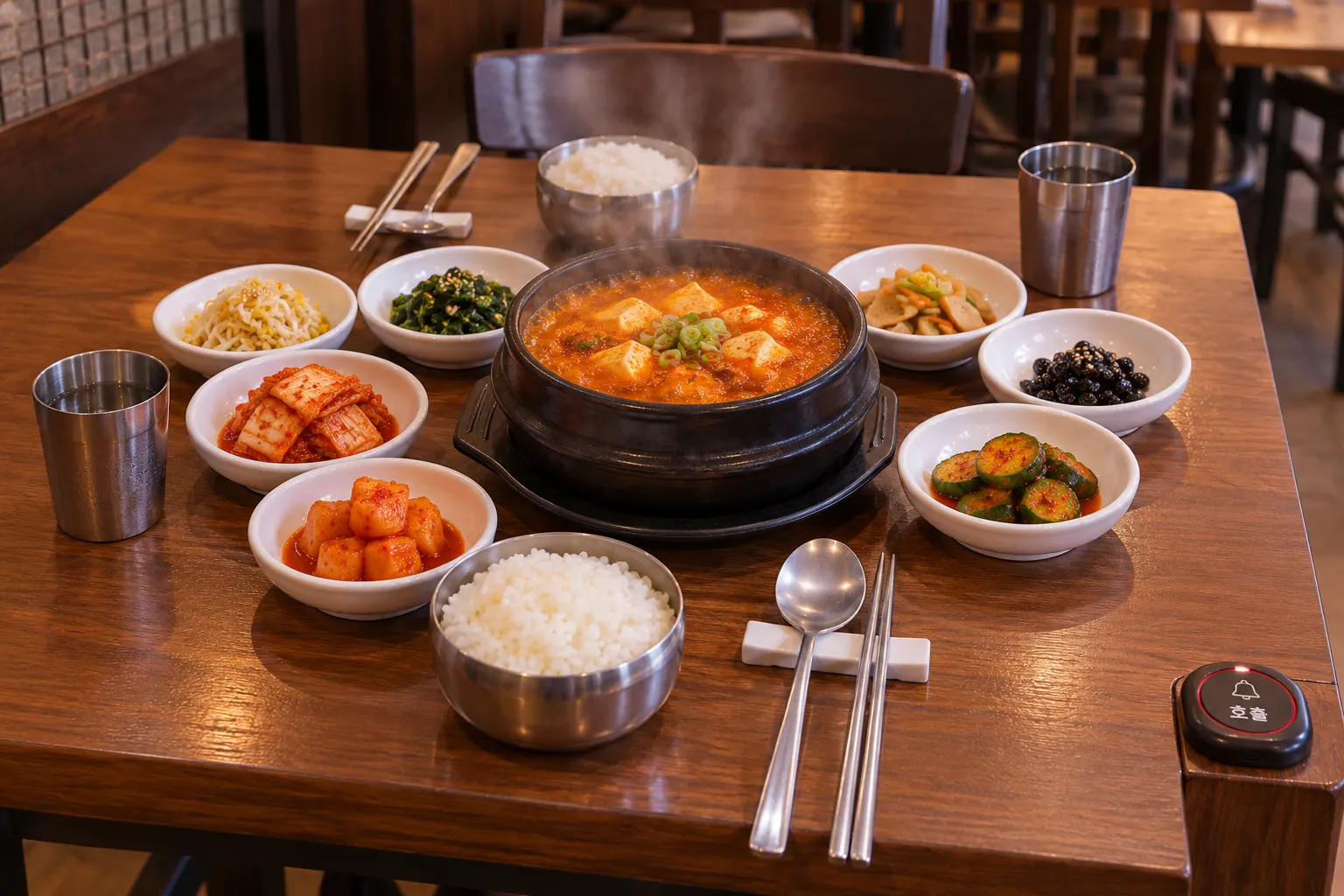
If you have ever sat in a Korean restaurant waiting for someone to take your order, you were probably missing the call button. Dining out in Korea runs on a different rhythm from restaurants in many countries: you often call staff yourself, water and side dishes are self-serve, you pay at the counter, and no one expects a tip. Once you know the pattern, eating out becomes quick, cheap, and easy, even with no Korean.
Here is how ordering, paying, and eating alone actually work, and where first-time diners usually stumble.
The Quick Answer: What Is Different
- Staff do not check on you constantly. You call them when you are ready.
- Prices on the menu usually include tax, and tipping is not expected.
- Water and many side dishes are free and self-serve.
- You usually pay at the counter when you leave, not at the table.
How to Order
Call button (호출벨). Many tables have a small button. Press it and staff will come. If there is none, say "저기요" (jeogiyo) or "여기요" (yeogiyo) and raise your hand.
Kiosks and tablets. Casual restaurants and chains often use a kiosk at the entrance or a tablet on the table. Most have an English setting, and you pay on the screen.
Pointing and photos. If the menu is in Korean, point at the item, show a photo, or say "이거 주세요" (igeo juseyo), meaning "this one, please."
Useful phrases include "맵지 않게 해주세요" (not spicy, please) and "포장해 주세요" (takeout, please).
Water, Side Dishes, and Utensils
Water is usually self-serve from a cooler or a jug. Utensils are often in a drawer or a small box on the table, along with napkins.
Side dishes (banchan) come with most traditional meals. At many restaurants, refills are free if you ask politely with "더 주세요" (deo juseyo). Order one main dish per person rather than sharing a single main, because restaurants expect that.
Paying and Splitting the Bill
You usually take the bill to the counter and pay on your way out. Some fast-casual places want payment first at the kiosk. Splitting a bill is handled in two common ways:
- One person pays, and everyone transfers their share by app, which is very common among Koreans, as covered in the QR payment guide.
- Some restaurants will split a card payment if you tell them before paying, while others will not, so ask first.
Foreign cards usually work at most restaurants, though small family-run places may prefer cash, as covered in the cash and card guide.
Eating Alone
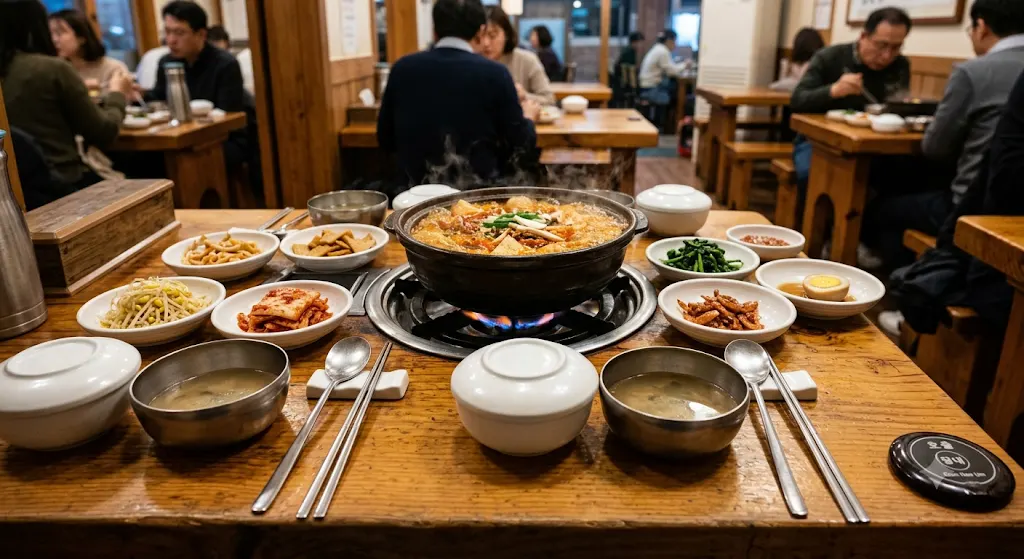
Solo dining (혼밥) is normal and increasingly easy. Good solo options include gimbap shops, noodle and ramen counters, rice soup (gukbap) restaurants, bibimbap places, and food courts.
The main exception is Korean barbecue. Many grill restaurants require a minimum of two portions, which can make solo diners pay for double. Ask "1인분 돼요?" (is one portion okay?) before sitting down, or choose a restaurant that advertises solo-friendly sets.
Timing, Reservations, and Waiting
- Break time (브레이크타임): many restaurants close between lunch and dinner, often in the mid-afternoon, so check the posted hours.
- Last order (라스트오더): the kitchen often stops taking orders 30 to 60 minutes before closing.
- Reservations and waitlists: popular places use apps such as Naver Booking, CatchTable, and Tabling. Some require a Korean phone number, while some offer English versions.
- Lunch sets: many restaurants offer cheaper lunch menus, and everyday lunches in Seoul often cost roughly 9,000 to 15,000 KRW.
Table Manners Basics
- Metal chopsticks and a spoon are standard. Use the spoon for rice and soup.
- Leave rice bowls on the table rather than lifting them.
- Never stick chopsticks upright in a bowl of rice, since it resembles a funeral ritual.
- Wait for the oldest person to start when eating with a group.
- At restaurants with floor seating, remove your shoes at the entrance.
- At grill restaurants, staff may cook the meat for you, and you can wrap it in lettuce with sauces.
Common Mistakes
- Waiting for a server who never comes. Use the button or call out.
- Sharing one main dish among several people. Order one per person.
- Arriving during break time. Check opening hours.
- Tipping at the table. It is not expected.
- Walking into a grill house alone without asking about portions. Minimums can apply.
Quick Summary
- Dining out in Korea relies on call buttons or kiosks, self-serve water and side dishes, and paying at the counter, with no tipping.
- Order one main dish per person, and ask politely for refills of banchan.
- Solo dining is easy at noodle shops and gimbap places, but barbecue restaurants often require two portions.
- Check break times and last-order times, and use Naver Booking, CatchTable, or Tabling for popular restaurants.