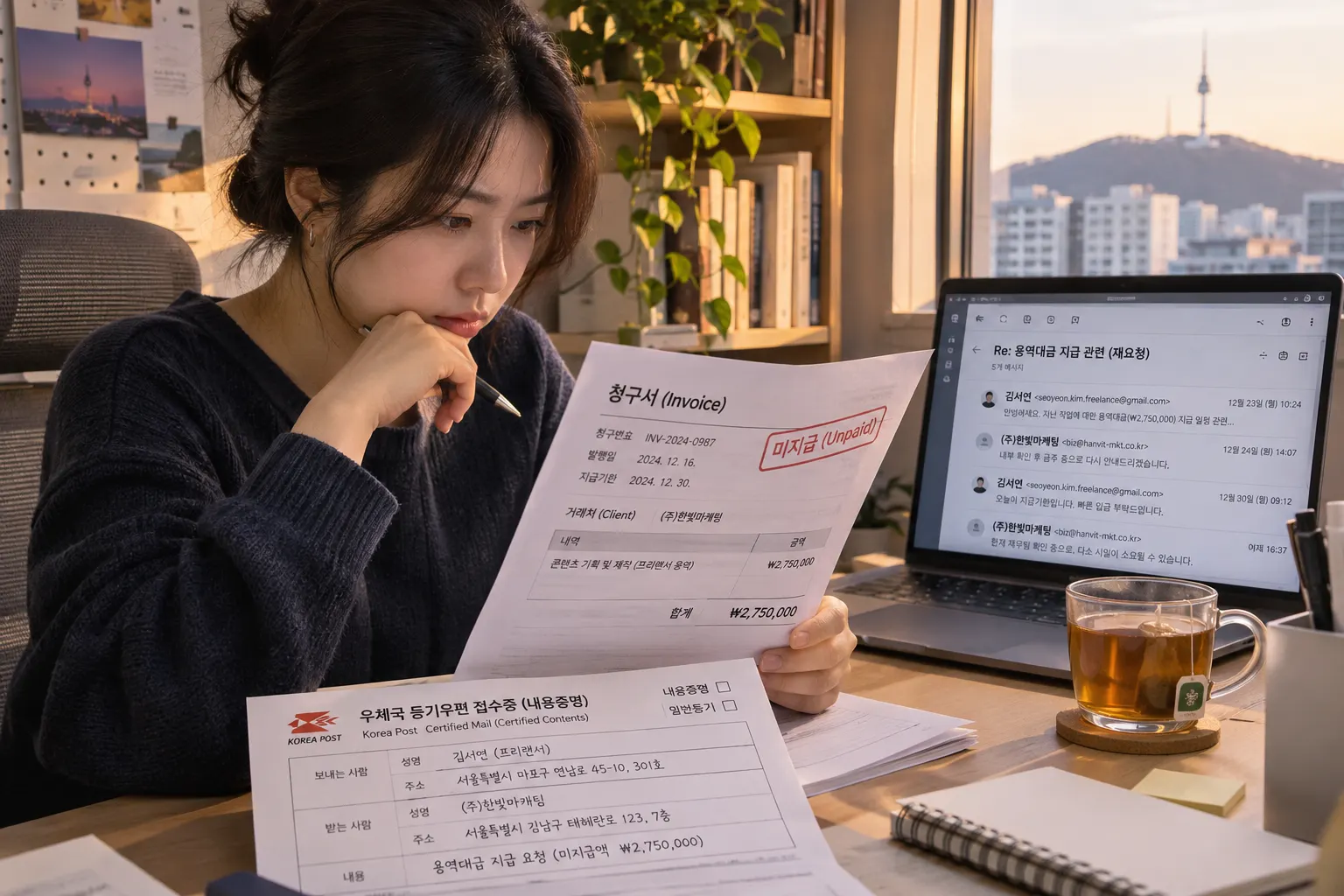
If a Korean client has gone quiet after you delivered the work, you are not stuck. Collecting an unpaid invoice from a Korean client usually follows a clear ladder: a polite written reminder, a formal certified notice, and then a court payment order if the money still does not arrive. Starting early, with the right paperwork in place, is what separates freelancers who get paid from those who give up.
This is general information, not legal advice. Court limits and fees change, so confirm the current figures before you file.
Step 1: Check Your Paper Trail
Before you chase anyone, collect what proves the debt:
- The contract, quote, or order confirmation showing the amount and payment date
- Proof of delivery, such as emails, files sent, or a client's approval message
- The tax invoice (세금계산서) you issued, as covered in the freelancer invoicing guide
- Your messages with the client, saved as screenshots or exports
Also check the payment terms. Many Korean companies pay on a fixed monthly cycle, for example at the end of the month after the invoice, so "late" may simply mean you have not reached their payment date yet.
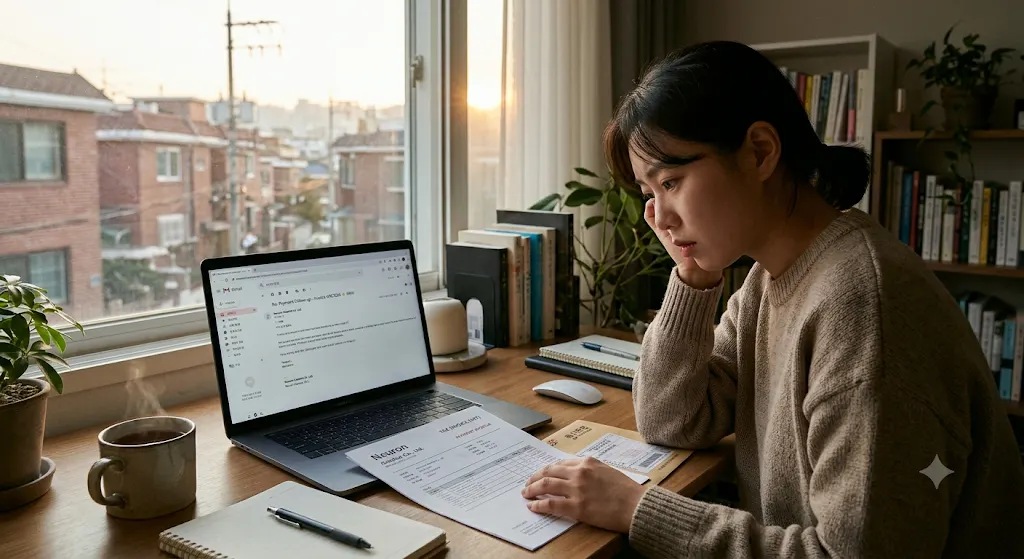
Step 2: Send a Polite Written Reminder
Korean business communication tends to be indirect, as covered in the business email guide, so open with a courteous message rather than an accusation. A good reminder includes:
- The invoice number, amount, and original due date
- Your bank account details
- A clear new deadline, such as seven days
- A question about whether anything is holding up approval on their side
Send it by email and by the messenger the client normally uses. Keep a record of every message.
Step 3: Send a Certified Notice (내용증명)
If the deadline passes, the next step is a content-certified letter (내용증명) sent through Korea Post. The post office certifies what the letter said and when it was sent. It does not force the client to pay, but it creates strong evidence and shows you are serious, and many clients pay at this stage.
State the amount, the reason it is owed, a payment deadline, and that you will pursue legal remedies if it is not paid. Write it in Korean, using a translator, a scrivener (법무사), or an attorney if your Korean is limited, because wording matters if the dispute goes to court.
Step 4: File a Payment Order or Small Claim
If the notice fails, you can go to court without necessarily hiring a lawyer for a straightforward unpaid debt.
- Payment order (지급명령): a written procedure with no hearing and lower court fees than a full lawsuit. The client has about two weeks after receiving it to object. If they do not, the order becomes enforceable. If they do, the case moves to a regular lawsuit.
- Small claims (소액사건심판): a simplified, faster procedure for smaller amounts. As of 2026, the limit has generally been around 30 million KRW, but confirm the current figure.
- Where to file: the court electronic filing system at https://ecourt.go.kr lets registered users file online with identity verification, and you can also file on paper at the competent court.
You will need the client's exact legal name and address. Pull them from the business registration certificate or the corporate registry, as covered in the registration certificate guide, so the court can serve the documents.
Winning is not the same as being paid. If the client still does not pay, you may need enforcement (강제집행), such as seizing a bank account or receivables. A provisional attachment (가압류) can freeze assets earlier, but it usually requires a lawyer and a security deposit.
If You Are a Subcontractor
If your client is a larger company and you work as its subcontractor, the Subcontracting Fair Transaction Act can apply. In general, it requires payment within a set period after delivery, commonly 60 days, and you can file a complaint with the Korea Fair Trade Commission. Whether it covers you depends on the companies' size and the type of work, so ask for advice if you think it applies.
Where to Get Free or Low-Cost Help
- Korea Legal Aid Corporation (대한법률구조공단): offers consultation, and support with litigation for people who meet its criteria. Its site is https://www.klac.or.kr and its phone line is 132. Ask about eligibility as a foreign resident and about language support.
- Foreign resident support centers: some, such as the Seoul Global Center, run legal consultation days. Check whether your district offers one.
How to Prevent the Next Unpaid Invoice
- Use a written contract with the payment date, amount, and tax invoice timing
- Ask for a deposit or split payment by milestone
- Issue invoices promptly and keep proof of delivery
- Agree on late-payment terms in advance
- Check a new client's business registration before starting large jobs
Common Mistakes
- Waiting months before following up. Limitation periods can be short for some claims, so do not delay.
- Skipping written records. Verbal promises are hard to prove.
- Threatening the client in angry messages. It can hurt your case and the relationship.
- Forgetting the VAT. If you issued a tax invoice and the client never pays, ask an accountant about bad-debt rules.
- Filing without the correct company details. Service fails if the address is wrong.
Quick Summary
- Collecting an unpaid invoice in Korea usually moves from a written reminder to a certified notice (내용증명) to a court payment order or small claim.
- Keep your contract, delivery proof, tax invoice, and messages, and confirm the client's payment terms first.
- Payment orders and small claims can often be filed online through ecourt.go.kr, but winning still may require enforcement to collect.
- Use Korea Legal Aid or a foreign resident support center for guidance, and prevent repeat problems with deposits and clear contracts.