Splitting Bills in Korea: How Group Payments, Bank Transfers, and Dutch Pay Work
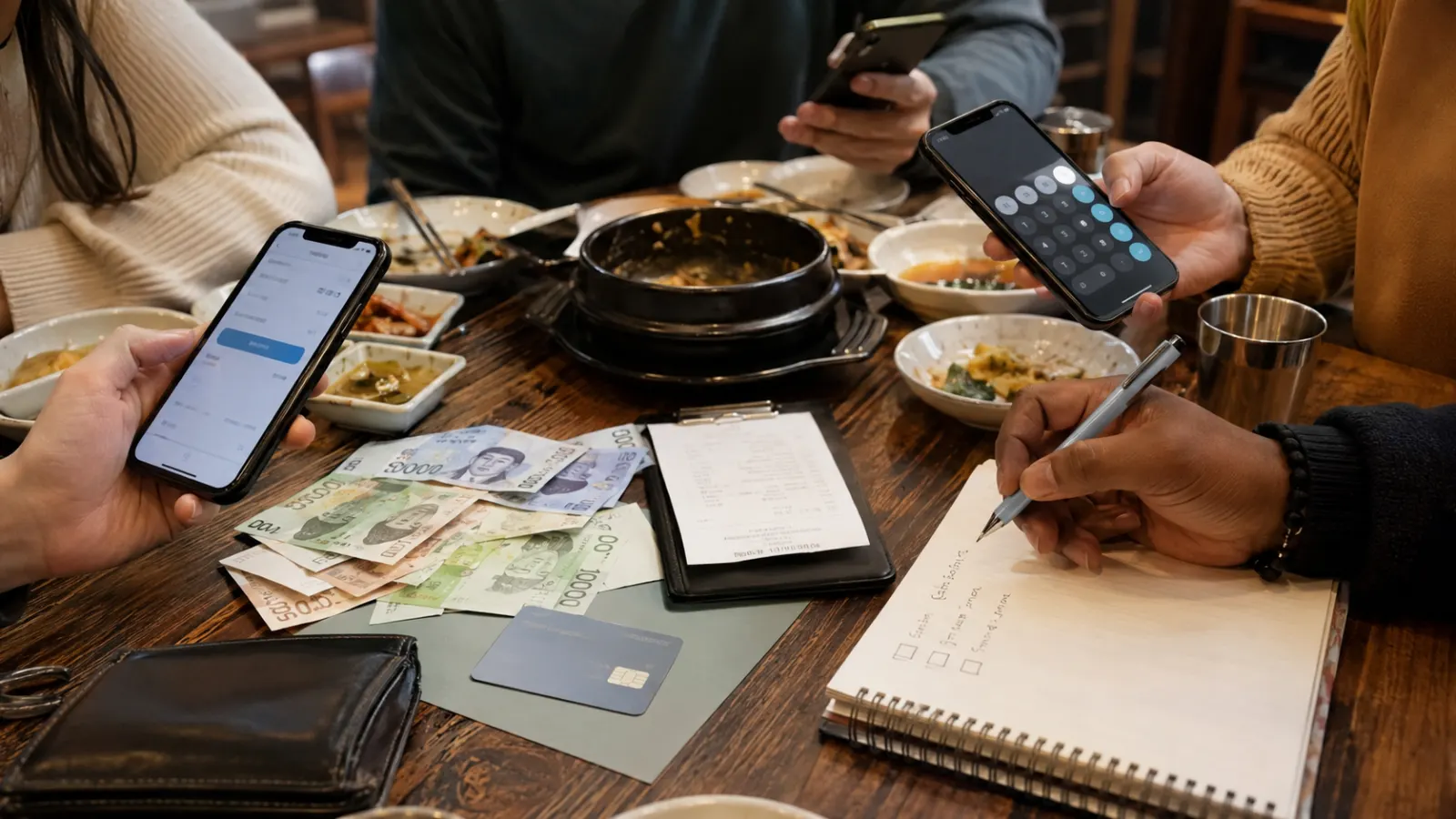
Eating with friends, joining a company dinner, sharing a taxi, or booking group accommodation often creates the same practical question: how should everyone divide the cost?
In Korea, one person commonly pays first and the others transfer their shares afterward. This system is fast when everyone has a Korean bank account and mobile banking, but it can be confusing for tourists, new residents, and groups using different payment methods.
Understanding “Dutch pay,” transfer etiquette, and payment timing can prevent awkward misunderstandings.
What “Dutch pay” means in Korea
The expression Dutch pay is commonly used in Korea to describe dividing a shared cost. It may mean:
- Equal split
- Paying only for what each person ordered
- One person paying and collecting transfers
- Dividing food separately from alcohol
- Rotating who pays across several gatherings
Do not assume the group has the same definition. Before ordering or booking something expensive, agree on the method. A simple question is:
“Are we splitting equally or by what each person orders?” This is especially useful when some people do not drink alcohol or when one person orders a much more expensive item.
One person often pays at the counter
Many Korean restaurants prefer one payment for the full table, particularly when the group ordered shared dishes. Separate card payments may be possible, but they can slow the checkout process or create confusion if the bill is not itemized clearly. A common process is:
- One person pays the restaurant.
- The receipt or total is shared in the group chat.
- Everyone sends a bank transfer.
- The payer confirms completion.
This works smoothly among local residents because domestic transfers are fast and frequently used. Tourists without Korean bank accounts need another arrangement.
Bank transfers are common
Korean residents often send money using mobile banking. The payer may share:
- Bank name
- Account number
- Account holder name
- Amount owed
Check the recipient name before sending. For privacy, avoid posting complete bank details in a large public group. Use a private group chat or direct message. When entering the transfer note, use your name or a recognizable description so the recipient can identify the payment.
Do not send a test transfer to an unknown account without verifying the person.
Payment request features
Some payment and messaging services provide group settlement or request-money functions. These can calculate each person’s share and notify group members. However, access may require:
- Korean identity verification
- Local phone number
- Korean bank account
- Supported app
- Matching legal information
- Domestic card
Do not assume every foreign resident can use the same feature. When one group member cannot access the tool, provide a simple alternative such as cash, card payment, or direct transfer.
Tourists and visitors
Tourists may not have access to Korean domestic transfers. Practical alternatives include:
- One person paying by foreign card
- Cash settlement
- Using an international payment app accepted by the group
- Taking turns paying for similar-cost meals
- Paying separately when the restaurant allows it
- Settling all shared expenses once at the end of the trip
Choose the method before the bill arrives. International transfers are usually impractical for a small restaurant share because fees and processing can exceed the amount owed.
Shared dishes make exact calculation difficult
Korean meals often involve shared food, side dishes, barbecue, stews, and drinks. Exact item-by-item calculation can become unrealistic. An equal split is usually simplest when everyone shared similar amounts.
A different split may be fairer when:
- One person did not drink
- A child ate very little
- Someone ordered a separate premium item
- One person arrived late
- Dietary restrictions limited participation
- Several people shared a dish that others did not touch
Discuss major differences openly without turning a small meal into a detailed accounting dispute.
Alcohol can be separated
At company dinners and social gatherings, alcohol may account for a significant part of the bill. People who do not drink may feel uncomfortable paying an equal share. A considerate group can separate:
- Food
- Alcohol
- Additional rounds
- Private orders
- Taxi expenses
Do not assume that non-drinkers are comfortable subsidizing the entire alcohol bill. At the same time, a small difference in an informal gathering may not justify an overly complex calculation. Use judgment based on the amount and group relationship.
Company dinners
A company dinner may be paid by:
- Employer
- Department budget
- Corporate card
- Senior employee
- Team members
- One person who later receives reimbursement
Do not assume that the highest-ranking person will pay. Ask a trusted coworker quietly when the custom is unclear. If the event is officially company-sponsored, employees should not be pressured to transfer money without an explanation.
Save the receipt when you are responsible for reimbursement.
Taxis and transportation
Splitting a taxi can be handled in several ways. The simplest method is one person paying the full fare and the others transferring their shares. When passengers get off at different locations, the split can be based on:
- Equal shares
- Distance
- Additional fare after each stop
- One person paying the extra detour
Agree before the trip when the route is long. For airport taxis, tolls and luggage-related costs may affect the final amount. Use the final receipt rather than estimating too early.
Group accommodation
For hotels, pensions, guesthouses, and vacation rentals, settle rules before booking. Confirm:
- Total price
- Deposit
- Cancellation responsibility
- Number of guests
- Different room types
- Extra-person fees
- Cleaning charges
- Refund method
- Who holds the reservation
- Deadline for transfers
The person making the reservation takes financial risk if others cancel later. Collecting deposits before final booking can reduce conflict. Do not assume a property will divide refunds among multiple people. The refund usually returns to the original payer.
Group gifts and events
Korean groups may collect money for:
- Wedding gifts
- Birthday presents
- Farewell gifts
- Funeral condolences
- Teacher gifts
- Team events
- Group meals
One person may organize the collection and purchase. For transparency, share:
- Contribution amount
- Deadline
- Payment method
- Purchase receipt
- Remaining balance
- Refund or additional collection
Do not pressure people into a voluntary contribution by presenting it as mandatory. Workplace gift collections should be handled carefully because hierarchy can make refusal uncomfortable.
Transfer timing
Send your share promptly. Waiting several weeks forces the payer to keep track of small debts and can create awkward reminders. A good habit is to transfer immediately after receiving the amount.
When you cannot pay on time, communicate clearly rather than ignoring the request. For recurring group activities, settle each event separately or maintain a shared record.
Common mistakes
Foreign residents often:
- Assume the restaurant will split the card payment
- Forget that one person covered the whole meal
- Send the wrong amount
- Transfer to the wrong account
- Use a name the recipient cannot recognize
- Ignore alcohol differences
- Wait too long to settle
- Book group accommodation without collecting deposits
- Assume an international payment service is available to everyone
Most problems are prevented by agreeing on the method before payment.
A practical group-payment checklist
Before a large shared expense:
- Confirm equal or itemized split
- Decide who pays first
- Check available payment methods
- Separate alcohol when appropriate
- Collect deposits for bookings
- Save the receipt
- Send the amount promptly
- Confirm the transfer recipient
- Track outstanding payments
- Handle refunds through the original payer
Splitting bills in Korea is usually simple once the group agrees on the process.
Quick Summary
- Korean groups commonly use one payment followed by domestic bank transfers.
- “Dutch pay” can mean equal or itemized splitting, so clarify the method.
- Tourists should agree on cash, cards, or another international option in advance.
- For accommodation and large bookings, collect deposits before the reservation is finalized.