You have a half-used packet of prescription tablets, an expired bottle of cough syrup, or medication left over from a clinic visit in Seoul. Can you throw it into your regular household trash? In Seoul, unused and expired medicines have a separate collection system, and some can even be deposited in ordinary street mailboxes.
Direct answer: Dispose of expired or unwanted medicine at a designated pharmaceutical waste collection box in Seoul. Sealed tablets, capsules, and powdered medicines can also be placed in Seoul mailboxes if properly packaged and labeled. Liquid medicines should go to a designated collection box, not a mailbox.
Here is how to prepare your medicine, find a collection point, and avoid common disposal mistakes.
Why You Shouldn't Put Medicine in Regular Trash
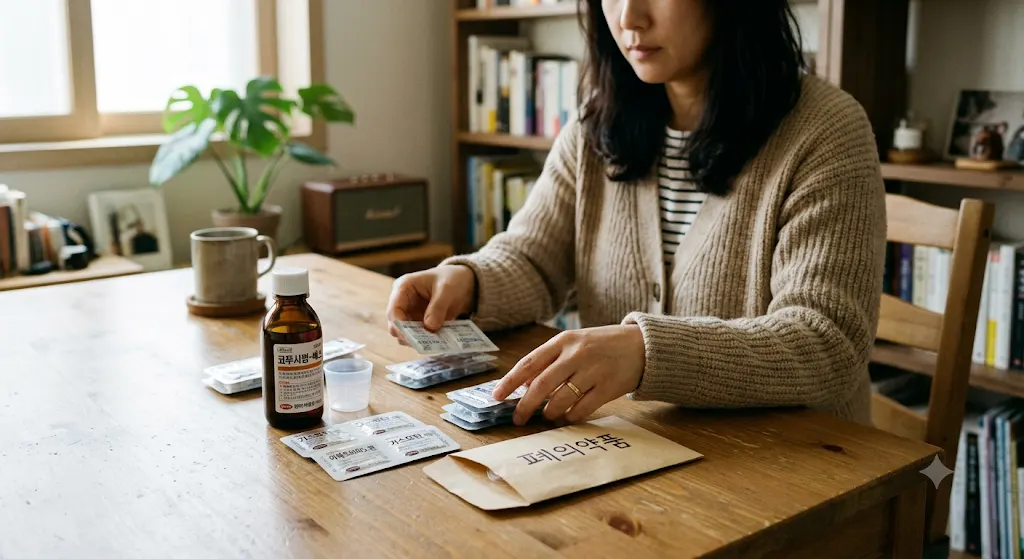
In Korean, discarded medicine is called 폐의약품 (pye-uiyakpum), meaning waste pharmaceuticals.
This category includes expired medicines and medication that is no longer needed. It can include prescription medicine and over-the-counter products.
Seoul treats discarded pharmaceuticals as household hazardous waste because pharmaceutical ingredients can enter soil and waterways when medicines are disposed of improperly.
Pouring leftover syrup down a sink or placing tablets in ordinary household waste is therefore not the recommended disposal method.
According to the Seoul Metropolitan Government's official disposal guidance, residents should use designated pharmaceutical collection facilities or approved mailbox collection methods.
The important distinction is that the correct disposal location depends on the form of the medication.
How to Prepare Different Types of Medicine
You do not need to empty every tablet or powder packet before disposing of it. In fact, opening sealed medication unnecessarily can create spills.
Seoul's guidance provides different instructions depending on the product.
Tablets and Capsules
For tablets and capsules:
- Keep individually sealed medicine packets or blister packaging intact.
- Remove unnecessary outer cardboard packaging where appropriate.
- Make sure loose packaging cannot spill its contents.
- Place the medicine in a designated pharmaceutical collection box or prepare it for mailbox disposal.
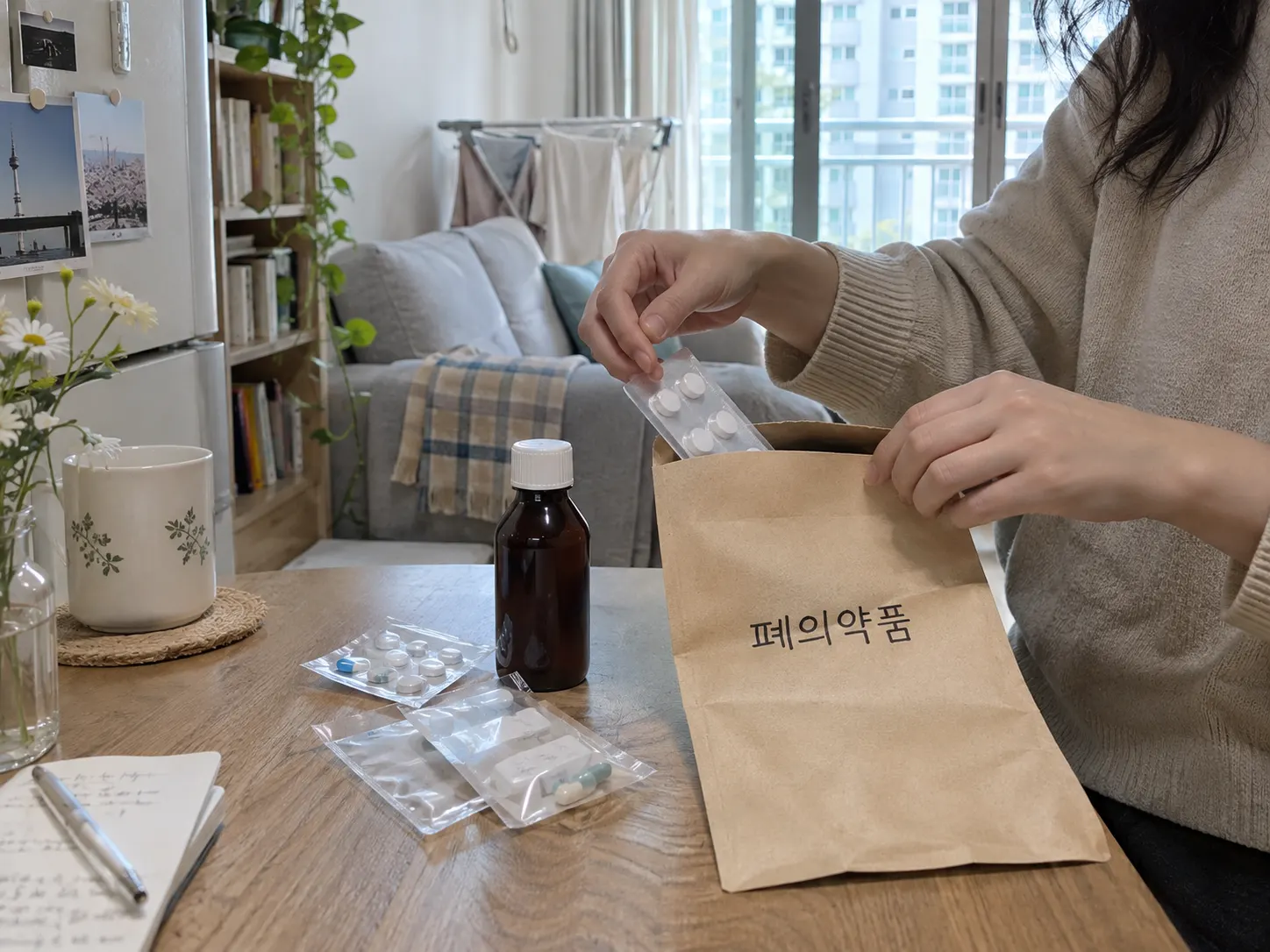
For prescription tablets packaged into individual daily doses by a Korean pharmacy, keep the sealed packets together rather than opening them.
Powdered Medicine
Powdered prescriptions are frequently supplied in small sealed packets.
Keep these packets closed. Do not empty the powder into a bag or container where it could become airborne or spill.
Sealed powdered medicine can be placed in a pharmaceutical collection box. Seoul also permits properly packaged powdered medicine through its mailbox collection system.
Liquid Medicine and Syrups
Liquid medicine requires extra care.
- Keep the liquid in its original container.
- Close the cap tightly.
- Use additional leak-resistant packaging where appropriate.
- Take it to a designated pharmaceutical collection box.
Do not place liquid medication in a Seoul mailbox.
The city excludes liquids from mailbox collection because leakage could contaminate ordinary mail.
Ointments, Eye Drops, and Other Containers
Ointments and similar pharmaceutical products should remain in securely closed containers.
Seoul's public health guidance directs residents to use dedicated collection boxes for ointments rather than mailboxes.
For eye drops and other liquid preparations, follow the same collection-box approach.
If you have used needles, syringes, or another potentially sharp medical item, do not assume it belongs in an ordinary medicine collection box. Ask your local public health center for the appropriate disposal procedure.
You can review Seoul's instructions through its official pharmaceutical waste information.
Where to Dispose of Expired Medicine in Seoul
Seoul provides several collection options, but the most convenient location depends on where you live and what kind of medicine you need to discard.
Option 1: A Designated Collection Box
This is the most straightforward option, particularly for liquid medicines and products that cannot be placed in mailboxes.
Collection boxes can be found at designated locations such as:
- District offices (구청, gucheong)
- Community service centers (주민센터, jumin center)
- Public health centers (보건소, bogeonso)
- Certain apartment complexes and other participating facilities
Not every building or public facility necessarily has a collection box.
To find an actual location, use the official Smart Seoul Map.
Search for:
폐의약품
This is the Korean term for discarded pharmaceuticals.
The map is useful because it allows you to look for designated locations instead of assuming your nearest government office participates.
Seoul's September 29, 2025 announcement also describes a QR-code program at pharmacies to help residents locate collection boxes.
Option 2: A Seoul Street Mailbox
One unusual feature of Seoul's disposal system is that certain unwanted medicines can be placed in regular postal mailboxes.
This service is not for every type of medicine.
For permitted solid medicines:
- Collect the unwanted tablets, capsules, or sealed powdered medicine packets.
- Place them in a suitable envelope or securely sealed bag.
3. Write 폐의약품 clearly on the outside.
- Seal the package.
- Place it inside a Seoul mailbox participating in the collection system.
The Korean label is important because it identifies the contents as pharmaceutical waste rather than ordinary mail.
For a practical example, imagine you have several sealed prescription tablet packets left after treatment. You can put those packets together in a closed envelope, label it 폐의약품, and use the mailbox collection option.
A bottle of cough syrup, however, must go to a designated collection box instead.
Seoul's official mailbox disposal instructions explain the packaging and liquid-medicine restrictions.
Option 3: A Participating Pharmacy
It is easy to assume that every pharmacy accepts unused medicine, especially because pharmacies dispense the products.
However, pharmacy participation should not be taken for granted.
Seoul reported in September 2025 that pharmacies in seven districts were participating in their own pharmaceutical waste collection arrangements.
This does not establish that every pharmacy throughout Seoul accepts returns.
Before making a special trip, ask the pharmacy:
"폐의약품 수거하시나요?"
This means: "Do you collect unwanted medicines?"
If the pharmacy does not collect them, ask where the nearest designated collection box is located.
You can also consult the city's official collection information.
What About Expired Vitamins and Supplements?
An expired vitamin supplement is not necessarily treated as a discarded medicine.
Seoul distinguishes between pharmaceutical products and health functional foods, such as nutritional supplements.
For example, a product sold as a health functional food (건강기능식품) is not included in the same pharmaceutical collection category simply because it comes in tablet or capsule form.
Seoul's guidance states that health functional foods should be disposed of as general waste.
However, do not decide solely from the word "vitamin" on the package. A vitamin-containing product may be classified differently depending on whether it is a medicine or a health functional food.
Check the Korean product labeling, or ask a pharmacist if the classification is unclear.
What If You Live Outside Seoul?
Seoul's mailbox system should not be assumed to operate identically throughout South Korea.
Waste collection is organized locally, and the available facilities and disposal procedures may vary between municipalities.
The Korean government's 110 Government Call Center guidance explains that household pharmaceutical disposal arrangements depend on local government collection systems.
If you live in Incheon, Suwon, Busan, or another municipality, check your own city's official guidance rather than automatically following Seoul's mailbox procedure.
A useful Korean search phrase is:
[Your city or district] 폐의약품 수거함
This means "[location] pharmaceutical waste collection box."
If online information is unclear, contact the local district office or public health center.
Common Mistakes to Avoid
Several misunderstandings can cause problems even when you are trying to dispose of medicine responsibly.
Mistake 1: Pouring medicine down a drain
Do not pour unwanted syrup or other liquid medication into a sink or toilet. Use a designated collection point.
Mistake 2: Putting liquids into a mailbox
Seoul's mailbox option is intended for permitted medicines that can be safely packaged without leaking. Take liquid preparations to a dedicated collection box.
Mistake 3: Assuming every pharmacy collects medicine
Collection arrangements differ. Confirm participation before visiting.
Mistake 4: Opening every medicine packet
Sealed packets generally do not need to be emptied. Keeping them closed helps prevent accidental spills.
Mistake 5: Treating dietary supplements as medicines
Check whether the product is classified as a pharmaceutical or a health functional food before selecting a disposal method.
A Simple Disposal Checklist
If you are clearing out a medicine cabinet before moving apartments or leaving Korea, use this process:
- Separate the medication you no longer need from products you intend to keep.
- Identify tablets, powders, liquid medicines, and products in special containers.
- Keep medication securely packaged.
- Check the Smart Seoul Map for a nearby pharmaceutical collection point.
- Use a mailbox only for permitted solid medicines in a sealed, clearly labeled envelope.
- Take liquid medicines and other excluded products to a dedicated collection box.
- If the classification or disposal location is uncertain, confirm with a pharmacist or local public health center.
Do not discontinue prescribed medicine simply because you are reorganizing your supplies. If you are unsure whether a medicine is still needed, speak with the prescribing clinician or pharmacist before discarding it.
For broader household waste rules, see our related guide to recycling and trash disposal in Korea.
The procedures described here are based on Seoul Metropolitan Government and Korean government guidance checked on November 9, 2026. Always check your municipality's latest collection instructions before disposing of unusual medical products.
Quick Summary
- Expired and unwanted medicines in Seoul should go to designated pharmaceutical collection points, not ordinary household trash or drains.
- Sealed tablets, capsules, and powdered medicines may be placed in Seoul mailboxes when properly packaged and labeled 폐의약품.
- Liquid medicines, syrups, and ointments should be taken to dedicated pharmaceutical collection boxes.
- Use the Smart Seoul Map to locate collection facilities, and verify local rules if you live outside Seoul.