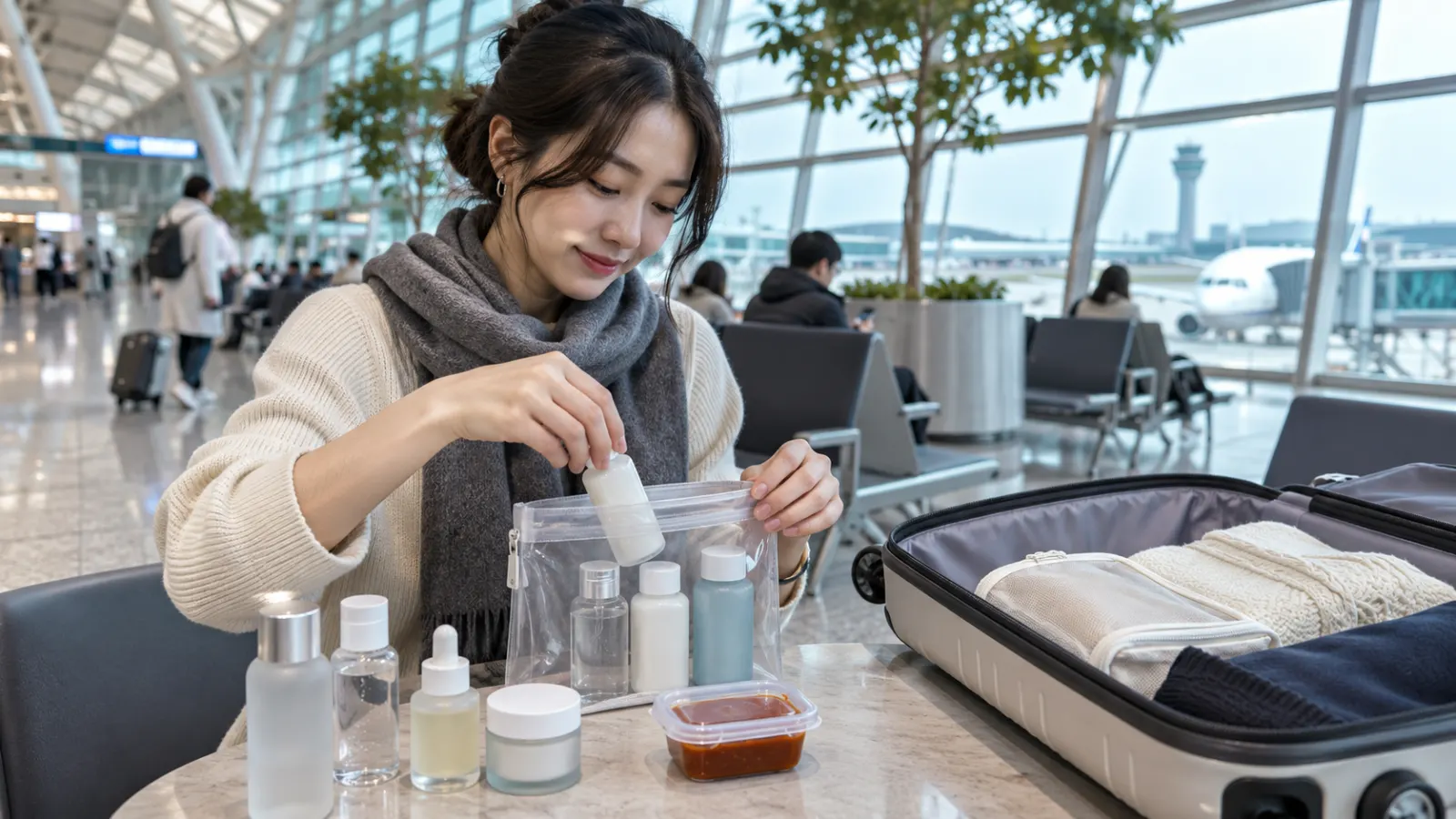
Incheon Airport Liquid Rules: Can You Bring Skincare, Kimchi, and Drinks?
You are flying internationally from Incheon Airport with Korean skincare products, bottled drinks, or food souvenirs. Before security screening, you need to know which items can stay in your carry-on bag and which should go into checked baggage.
For international flights departing from Incheon Airport, ordinary liquids, aerosols, and gels must be in containers of 100 mL or less and fit inside one transparent, resealable 1 L bag per passenger. The rule applies to cosmetics and certain Korean foods, including kimchi and gochujang.
The airport also publishes specific exceptions for medicines, baby food, and appropriately packaged duty-free purchases.
What Is the 100 mL Rule at Incheon Airport?
According to Incheon International Airport's official restricted-items guide, liquids, sprays, and gels are subject to quantity restrictions in international-flight carry-on baggage.
The standard requirements are:
Requirement | Limit |
|---|---|
Maximum container capacity | 100 mL |
Transparent bag capacity | 1 L |
Number of bags | One per passenger |
Bag condition | Resealable and closed |
The airport provides examples of suitable transparent bag dimensions, including approximately 20.5 × 20.5 cm or 15 × 25 cm.
The container's capacity matters, not how much liquid remains inside.
For example, a 200 mL shampoo bottle containing only 40 mL of shampoo does not satisfy the ordinary 100 mL container rule.
Transfer the product into an appropriate smaller container before traveling, or place it in checked baggage if permitted.
Can You Bring Korean Skincare Products?
Many Korean skincare products fall under the liquid, gel, or cream categories.
Examples include:
Toner and essence
Serum and liquid ampoules
Moisturizing lotion
Sunscreen cream
Liquid foundation
Shampoo and conditioner
Perfume
For ordinary carry-on screening, each container must be no larger than 100 mL, and the products must fit within your single transparent 1 L bag.
A set of ten 100 mL bottles is not automatically acceptable if the containers cannot fit inside the permitted bag.
What About Sheet Masks?
Sheet masks contain liquid or serum, so do not assume they are exempt simply because they are individually packaged.
The airport's general rules cover liquids and gel-type cosmetics.
If you are carrying a large quantity of sheet masks or unusual cosmetic packaging, check with the airport or airline before departure.
Can You Bring Kimchi or Gochujang in Carry-On Baggage?
This is a common problem for travelers buying Korean food souvenirs.
Incheon Airport explicitly identifies kimchi and gochujang as liquid or gel-type foods for security-screening purposes.
That means the ordinary 100 mL container and 1 L transparent bag restrictions apply when carrying them through international departure security.
For example, a large sealed container of kimchi cannot be treated as unrestricted solid food merely because it contains vegetables.
Similarly, gochujang is a paste and falls within the liquid and gel restrictions.
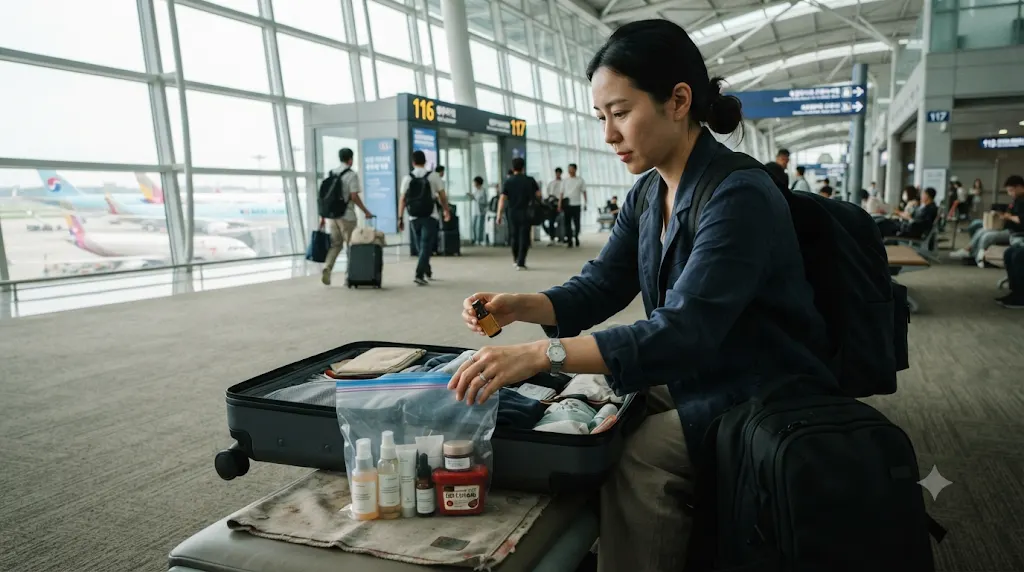
What About Checked Baggage?
The airport's general security guidance permits liquid and gel-type foods in checked baggage without the same 100 mL carry-on limit.
However, this does not override airline baggage conditions or the destination country's food-import restrictions.
A food product may pass Korean departure security but still be prohibited by the country you are entering.
Pack leak-prone foods securely and check the destination's customs and quarantine requirements.
Can You Bring Bottled Water or Coffee?
Ordinary bottled drinks are subject to the same international departure security rules.
A 500 mL bottle of water cannot pass through screening under the standard liquid allowance, even if most of the water has been consumed.
If you need a drink during your flight, consider obtaining one after security screening, subject to your airline and any onward transfer requirements.
Do not assume that liquids purchased after security will automatically be accepted during a connecting flight at another airport.
What About Duty-Free Liquids?
Incheon Airport publishes an exception for qualifying duty-free liquid purchases.
According to its transfer security guidance, duty-free liquids may be carried in an approved Duty Free Liquid Item Bag.
The bag must remain sealed until the final destination flight.
However, transfer airports in other countries may apply different screening requirements.
A duty-free purchase that is accepted when leaving Incheon could face additional restrictions during an international connection.
If your journey includes a transfer, check the transit airport's rules before buying large liquid products.
Can You Bring Liquid Medicines Over 100 mL?
Incheon Airport provides a specific exception for necessary liquid medicines.
Its official restricted-items FAQ states that passengers carrying liquid medicines exceeding 100 mL, such as insulin, must have a doctor's note or prescription in Korean or English.
The airport explains that carry-on quantities should be limited to what is needed during the flight, subject to security assessment.
Additional quantities may need to be checked, where transport is permitted and appropriate.
Travelers should also consider medicine storage requirements. A temperature-sensitive medicine should not be placed in checked baggage without confirming that doing so is medically and practically suitable.
What About Baby Food?
The airport publishes an allowance for food and liquids needed by children younger than six years old during the flight.
Examples include milk, water, juice, and certain prepared foods.
The allowance concerns quantities reasonably needed during travel, not unlimited supplies.
Inform security staff if you are carrying these items.
Are Domestic Flights Different?
Yes.
Incheon Airport's official restricted-items guidance distinguishes domestic flights from international flights.
The ordinary international 100 mL liquid-container restriction does not apply in the same way to domestic flights.
However, dangerous goods, airline baggage policies, and other security restrictions still apply.
Do not assume that every liquid or aerosol is permitted simply because the flight is domestic.
What If You Forgot a Transparent Bag?
The airport's official FAQ states that suitable transparent bags can be purchased at convenience stores in the passenger terminals.
Nevertheless, preparing your liquids before arriving at security is more convenient.
Place the bag somewhere accessible so that you can present it if screening staff request it.
Common Mistakes to Avoid
Counting the Remaining Liquid Instead of the Container Size
A partly empty oversized bottle does not meet the standard restriction.
Treating Kimchi as Ordinary Solid Food
The airport specifically includes kimchi in its liquid and gel food restrictions.
Assuming Checked Baggage Means Unrestricted Import
Destination-country customs rules are separate from Korean departure screening.
Opening Duty-Free Liquid Packaging Before a Connection
Breaking the sealed packaging can affect whether the item is accepted at another security checkpoint.
Assuming All Medicines Are Automatically Exempt
Supporting documentation and the quantity needed during travel may matter.
Before You Go Through Security
Check the capacity of each liquid or gel container. Place ordinary carry-on liquids in one sealed transparent 1 L bag. Separate any medicines or baby food that require special screening, and retain the necessary supporting documents.
If you are carrying unusual products, check the airport's official restricted-items information or contact Incheon Airport customer service at 1577-2600.
The rules in this article were checked against Incheon International Airport's official guidance on November 18, 2026. Individual airline and transfer-airport requirements may differ.
Quick Summary
Ordinary liquids, sprays, and gels in international carry-on baggage must be in containers of 100 mL or less and fit into one transparent 1 L bag.
Korean skincare products, kimchi, and gochujang can fall under these restrictions.
Necessary medicines, baby food, and properly sealed duty-free purchases have specific exceptions.
Checked baggage rules and destination-country import requirements must be checked separately.