How Korean Business Email Etiquette Differs From Western Norms
If you've sent a casual, friendly email to a Korean business contact and received a notably more formal, structured reply, or felt unsure how to close an email to someone senior, you've run into one of the more understated but consistent differences in Korean professional communication. Business email etiquette in Korea follows conventions that reflect the same hierarchy-aware culture found in meetings and titles, but expressed through writing rather than spoken interaction.
Here's what actually differs, and how to adjust without over-formalizing to the point of sounding stiff.
Opening and Closing Conventions
Korean business emails generally follow a more structured opening and closing than many Western business emails, which increasingly favor brevity.
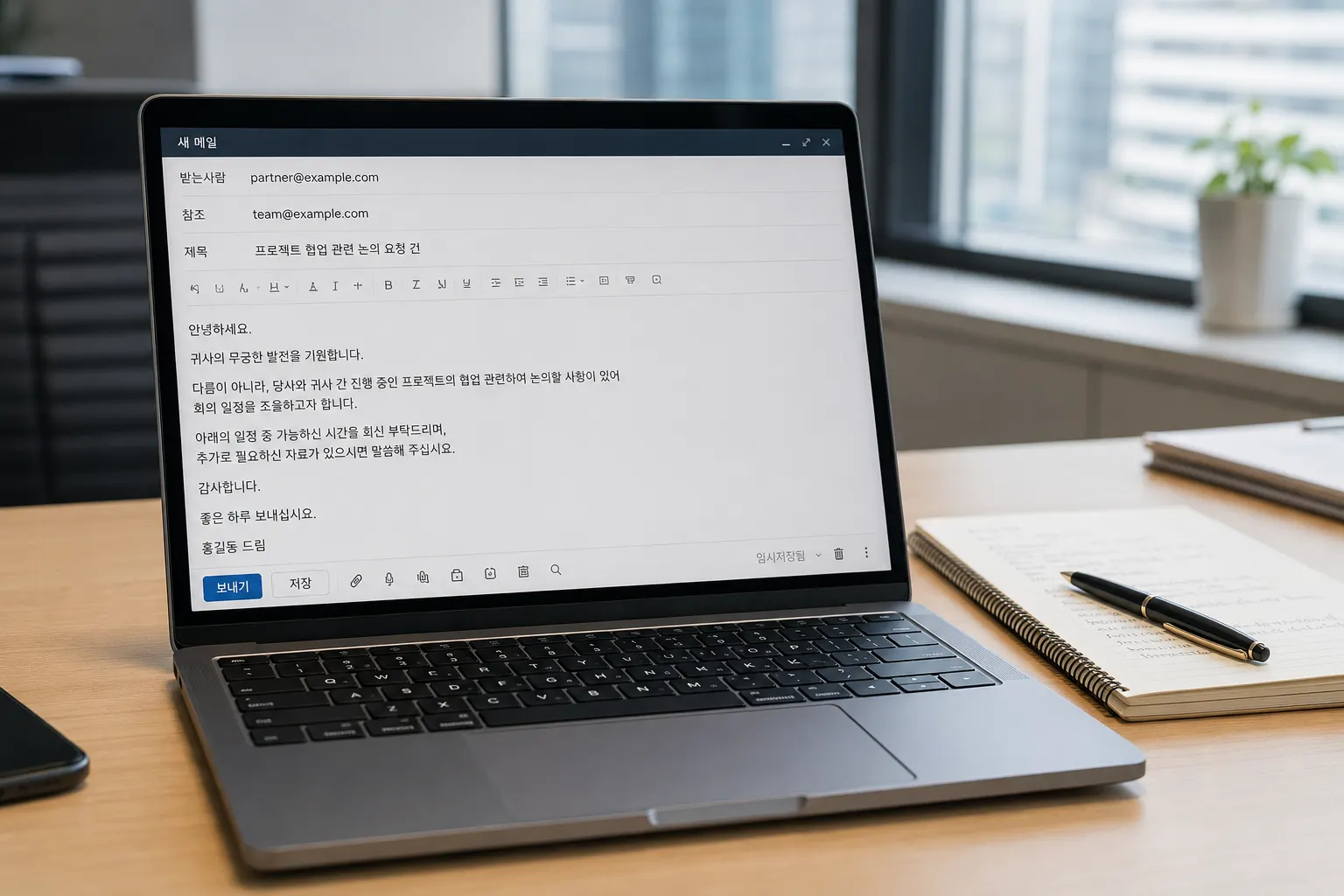
- A greeting that references the recipient's position or company, rather than a simple "Hi [Name]," is common in more formal Korean business correspondence, something closer to "Hello, this is [Name] from [Company]" as an opening line, even mid-conversation, rather than jumping straight into the message content.
- Closing lines expressing thanks or well-wishes are more standard than in many Western business emails, which sometimes end abruptly after the core message. A brief closing sentence expressing appreciation for the recipient's time or cooperation is generally expected, even in relatively routine correspondence.
- Full name and title in the signature, rather than just a first name, reinforces the same title-consciousness present in spoken workplace communication.
Formality Level and Directness
- Korean business emails tend to be somewhat more indirect in delivering less positive news or requests, similar to the indirectness that shows up in in-person meetings, a direct "no" or blunt refusal in writing is less common than a softened explanation of difficulty or constraints.
- CC and reply-all conventions sometimes carry more procedural weight than in some Western contexts, keeping relevant senior staff or department heads CC'd on certain communications isn't just informational courtesy, it can reflect an expectation around transparency and hierarchy awareness within a specific company culture.
- Response time expectations can be faster than some foreign employees are used to, particularly for internal communication, a same-day or next-business-day response is often expected for routine internal emails, delayed responses without acknowledgment can be read as a lack of attentiveness.
Common Mistakes Foreign Employees Make
- Being too casual too quickly, especially with someone senior. An email that reads as friendly and efficient in a Western context can come across as underdressed for the relationship in a more traditional Korean business setting, particularly in early professional correspondence before rapport is established.
- Skipping the closing pleasantries entirely. Ending an email abruptly right after the core request or information, without any closing acknowledgment, can read as curt even if unintentional.
- Not using appropriate titles in the greeting or throughout the email. Referring to someone by first name alone in written correspondence, when Korean convention would use a title, mirrors the same missteps that show up in spoken address.
- Underestimating expected response speed for internal communication. Assuming a day or two delay is acceptable for internal Korean workplace email can create a different impression than intended, particularly at companies with faster internal communication norms.
Language Considerations for Non-Korean Speakers
- Writing in clear, simple English rather than attempting formal Korean phrasing you're not confident in is generally the safer choice if your Korean isn't strong, most business contacts working with foreign staff expect and accommodate English correspondence, forced or incorrect formal Korean can occasionally land more awkwardly than clear, professional English.
- Using a translation tool to check tone, not just literal meaning, before sending anything sensitive or important, since directness that reads as normal in English can occasionally translate as overly blunt if a recipient is reading a Korean-translated version through their own tool.
- Confirming important agreements or decisions made verbally with a follow-up email is a widely appreciated practice in Korean business culture, providing a clear written record aligns well with the general preference for documented clarity, particularly for anything involving commitments or numbers.
How This Varies by Company Culture
Startups, tech companies, and international-facing teams have generally adopted more casual, direct email norms closer to global standard business English conventions, while larger, more traditional Korean companies tend to maintain the more formal structure described above. Observing how your specific colleagues and counterparts write, rather than assuming a single universal standard, remains the more reliable approach, matching the register of the people you're actually corresponding with tends to work better than defaulting rigidly to either extreme.
Quick Summary
- Korean business emails often use more structured openings, closings, and title-based address than many Western business emails, reflecting the broader hierarchy-consciousness of Korean workplace culture.
- Requests or negative news are often delivered more indirectly in writing, similar to spoken communication norms, a direct blunt refusal is less common than a softened explanation.
- Internal email response time expectations can be faster than some foreign employees anticipate, delayed responses without acknowledgment can be read as inattentive.
- Company culture varies significantly, startups and international-facing teams tend toward more casual norms, observing your specific counterparts' style is more reliable than assuming one fixed standard applies everywhere.