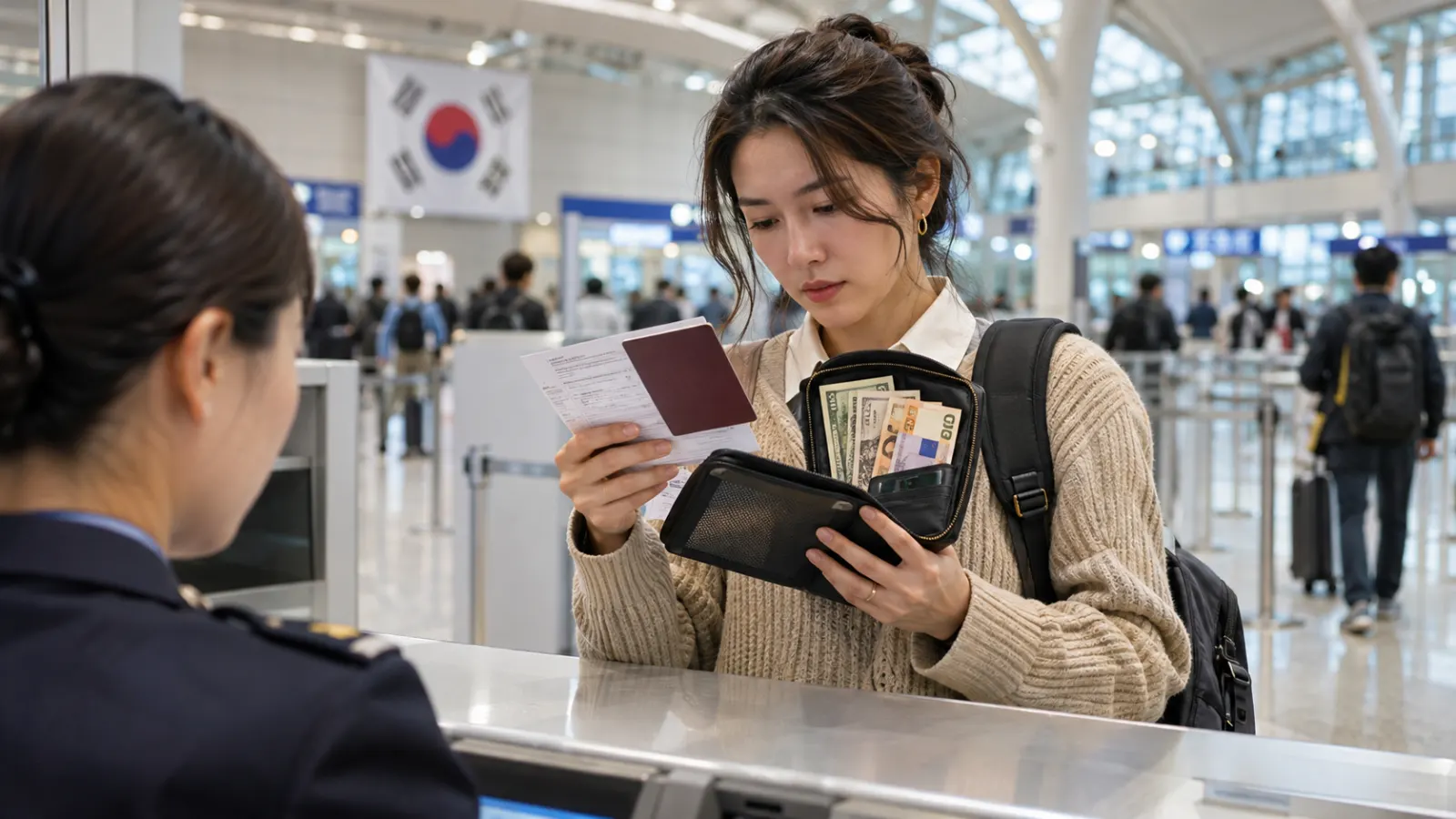
You are arriving in South Korea with cash for tuition, living expenses, business travel, or an extended stay. Do you need to declare it at the airport, and does the rule apply only to US dollars?
Travelers entering South Korea must declare cash and other covered means of payment when their combined value exceeds US$10,000 or the equivalent in other currencies. The threshold applies to the total covered amount, not separately to each currency.
The Korea Customs Service provides an official declaration procedure, and travelers who fail to report qualifying amounts may face penalties.
What Is Korea's Cash Declaration Threshold?
The Korea Customs Service explains that travelers bringing covered means of payment into Korea do not need a declaration when the total does not exceed US$10,000.
When the combined value exceeds that amount, a customs declaration is required.
The distinction between "exceeds" and "equals" matters.
The published rule uses a threshold of amounts above US$10,000.
However, travelers should check the applicable exchange-rate calculation if they are carrying several currencies close to the limit.
The requirement concerns declaration, not a general prohibition on bringing larger amounts into Korea.
Which Types of Money Count?
The official customs guidance identifies foreign currency, Korean won notes, and checks among the covered payment instruments.
This means the declaration threshold is not limited to US dollar banknotes.
For example, a traveler may carry:
- US dollars
- Euros
- Japanese yen
- Korean won
- Certain checks or other covered payment instruments
The relevant total is calculated using the applicable equivalent value.
Example: Carrying Several Currencies
Suppose you arrive with:
- US$6,000 in banknotes
- Euros equivalent to US$3,000
- Korean won equivalent to US$2,000
The combined amount is approximately US$11,000.
Because the total exceeds US$10,000, the declaration requirement applies.
The figures are illustrative, not current exchange-rate quotations.
A traveler cannot avoid the threshold simply by dividing money between several currencies.
How to Declare Cash When Entering Korea
The Korea Customs Service publishes a procedure for travelers carrying amounts above the declaration threshold.
Step 1: Calculate the Total Before Arrival
List the currencies and covered payment instruments you are bringing.
Convert them to a US dollar equivalent using an appropriate exchange rate.
If your total is near the threshold, confirm the applicable customs calculation rather than relying on an approximate currency-conversion app.
Step 2: Declare the Amount to Customs
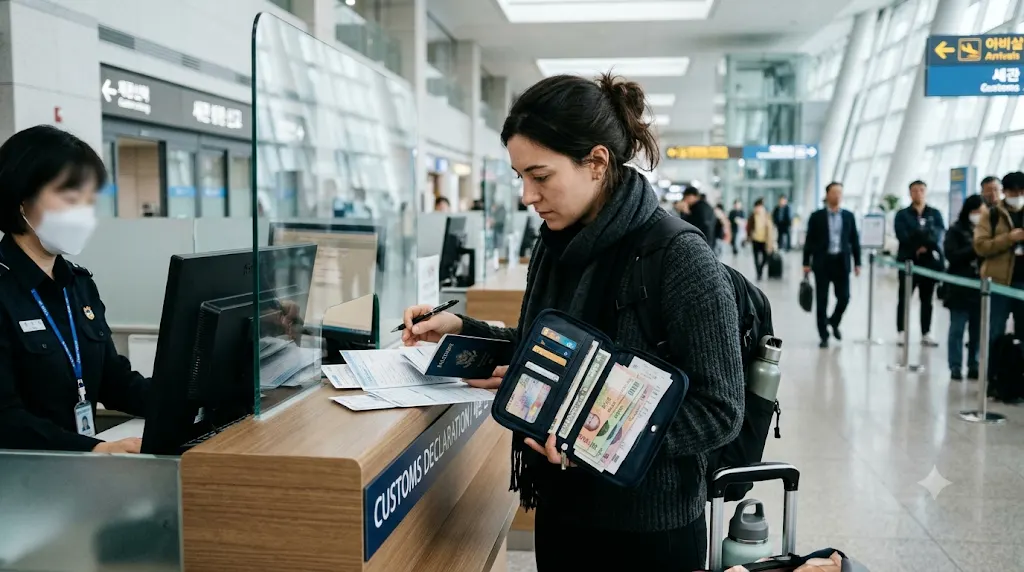
The customs guidance instructs travelers to report the relevant amount through the traveler declaration procedure.
The official English instructions describe indicating the currency declaration on the traveler declaration form and submitting it to a customs officer.
Because declaration channels and forms can change, follow the current instructions at the arrival airport.
Do not assume that completing an immigration arrival declaration also satisfies the customs cash declaration requirement.
Step 3: Provide Accurate Information
Be prepared to identify the amount and types of currency you are carrying.
Answer any questions from customs officials accurately.
If officials request additional documentation, follow their instructions.
Do not provide false amounts or omit covered payment instruments.
Step 4: Obtain the Declaration Certificate
The Korea Customs Service explains that travelers who complete the procedure receive a Certificate of Foreign Currency Declaration.
Keep this certificate with your travel and financial records.
The official guidance specifically warns that the certificate cannot be issued retrospectively after completing the relevant arrival process.
This is an important reason to declare qualifying amounts before leaving the customs area.
Is Declaring Cash the Same as Paying Tax?
No.
A cash declaration is a reporting requirement under Korea's foreign exchange rules.
It is not automatically a tax on the money you carry.
However, declaring money does not establish that every later transaction involving that money is tax-exempt.
For example, the tax treatment of income, gifts, business receipts, or other funds depends on separate rules.
A customs declaration certificate also does not replace any documentation that a Korean bank may require when accepting a large deposit.
If you intend to deposit the money after arrival, ask the receiving bank about its identification and source-of-funds requirements.
What Happens If You Fail to Declare?
The Korea Customs Service warns that failure to declare covered means of payment can result in fines or criminal penalties.
Its official guidance cites the Foreign Exchange Transactions Act and related regulations.
The consequences depend on the circumstances and applicable law.
Do not assume that an undeclared amount will simply be accepted after paying a small administrative fee.
If you discover a mistake while still within the arrival process, approach customs officials immediately rather than attempting to leave without clarification.
Does the Rule Apply to Every Traveler?
The general inbound declaration rule applies to travelers carrying covered means of payment into South Korea.
It is not limited to tourists.
A foreign student, business traveler, returning resident, or Korean citizen may also need to declare qualifying amounts.
However, particular foreign exchange procedures can differ according to the traveler's circumstances and the type of payment instrument.
For example, rules for physically carrying cash should not be confused with rules governing international bank transfers.
If you are transferring money electronically, consult the relevant bank and foreign exchange requirements rather than assuming the airport cash declaration process applies.
What About Families Traveling Together?
Do not assume that dividing a large amount among family members automatically removes reporting obligations.
The correct treatment depends on who owns and carries the money and the applicable customs rules.
If several travelers are transporting funds together, especially money belonging to one person or business, seek clarification from the Korea Customs Service before departure.
The official guidance reviewed for this article does not establish a universal household exemption.
What If You Are Leaving Korea With Cash?
This article addresses the general declaration rule for travelers entering South Korea.
Taking money out of Korea may involve additional rules, including distinctions based on residence status and the origin of the funds.
Do not assume that the inbound procedure is identical to the outbound procedure.
Check the Korea Customs Service's current departure guidance before carrying a large amount of money overseas.
Common Mistakes to Avoid
Mistake 1: Counting Only US Dollars
Other currencies and covered payment instruments may count toward the total.
Mistake 2: Assuming the Threshold Applies Separately to Each Currency
The published rule concerns the combined equivalent value.
Mistake 3: Confusing Customs Declaration With Immigration Forms
They serve different purposes.
Mistake 4: Leaving the Airport Without Obtaining the Required Certificate
The customs guidance warns that the certificate cannot be issued retrospectively after completing the arrival process.
Mistake 5: Assuming Declaration Automatically Resolves Banking or Tax Questions
Banks and tax authorities may have separate documentation requirements.
Where to Confirm the Rules
Use the Korea Customs Service's official foreign currency declaration guidance.
For travelers arriving at Incheon International Airport, the guidance identifies airport customs offices responsible for the procedure.
Check the current contact information and airport instructions before departure if you are carrying an amount close to or above the threshold.
The customs information in this guide was checked on November 11, 2026.
Quick Summary
- Declare covered cash and payment instruments when their combined value exceeds US$10,000 or the equivalent upon entering South Korea.
- Korean won, foreign currencies, and certain checks count toward the declaration threshold.
- Complete the customs procedure before leaving the relevant arrival area and retain the declaration certificate.
- Cash declaration is separate from immigration requirements, banking documentation, and tax obligations.