How to Open a Korean Bank Account as a Foreigner
Opening a Korean bank account sounds like a simple errand until you are standing at a branch with a passport, a residence card, a phone number, and still one missing document. For many foreigners, banking in Korea is not difficult because banks are unfriendly. It is difficult because banking, phone verification, immigration records, and anti-fraud rules are tightly connected.
A Korean bank account can make daily life much easier. It helps with rent, salary, tuition, subscriptions, online shopping, delivery apps, transfers, refunds, and local payment services. But the best way to open one depends on whether you are a tourist, student, employee, freelancer, or long-term resident.
Why a Korean bank account matters
You can survive in Korea for a short trip with a foreign card and some cash. But once you stay longer, a local bank account becomes more than a place to store money.
Many everyday systems expect domestic banking. Employers usually pay salary into a Korean account. Landlords may ask for bank transfers. Schools may refund deposits locally. Some apps work better with Korean cards. Online shopping, delivery apps, local subscriptions, and utility payments can also become smoother once you have a domestic account and card.
The common misunderstanding is thinking a Korean bank account is only about money. In practice, it often becomes part of your local identity setup, together with your residence card and Korean phone number.
Who can open an account?
Foreign residents with proper identification can usually open a Korean bank account, but the process is not always the same for everyone. A student at a Korean university, an employee with a work visa, a spouse visa holder, and a short-term visitor may be treated differently.
Short-term visitors may face more restrictions. Some banks may be cautious if you do not have a residence card, local address, or clear purpose for the account. Long-term residents usually have a smoother path, especially if they can show a foreigner residence card, passport, local address, and reason for opening the account.
The bank may also ask about your purpose: salary, tuition, rent, living expenses, business activity, remittance, or investment. This is not just curiosity. Banks have to follow financial crime prevention rules, so vague answers can lead to limited services or a rejected application.
Documents foreigners should prepare
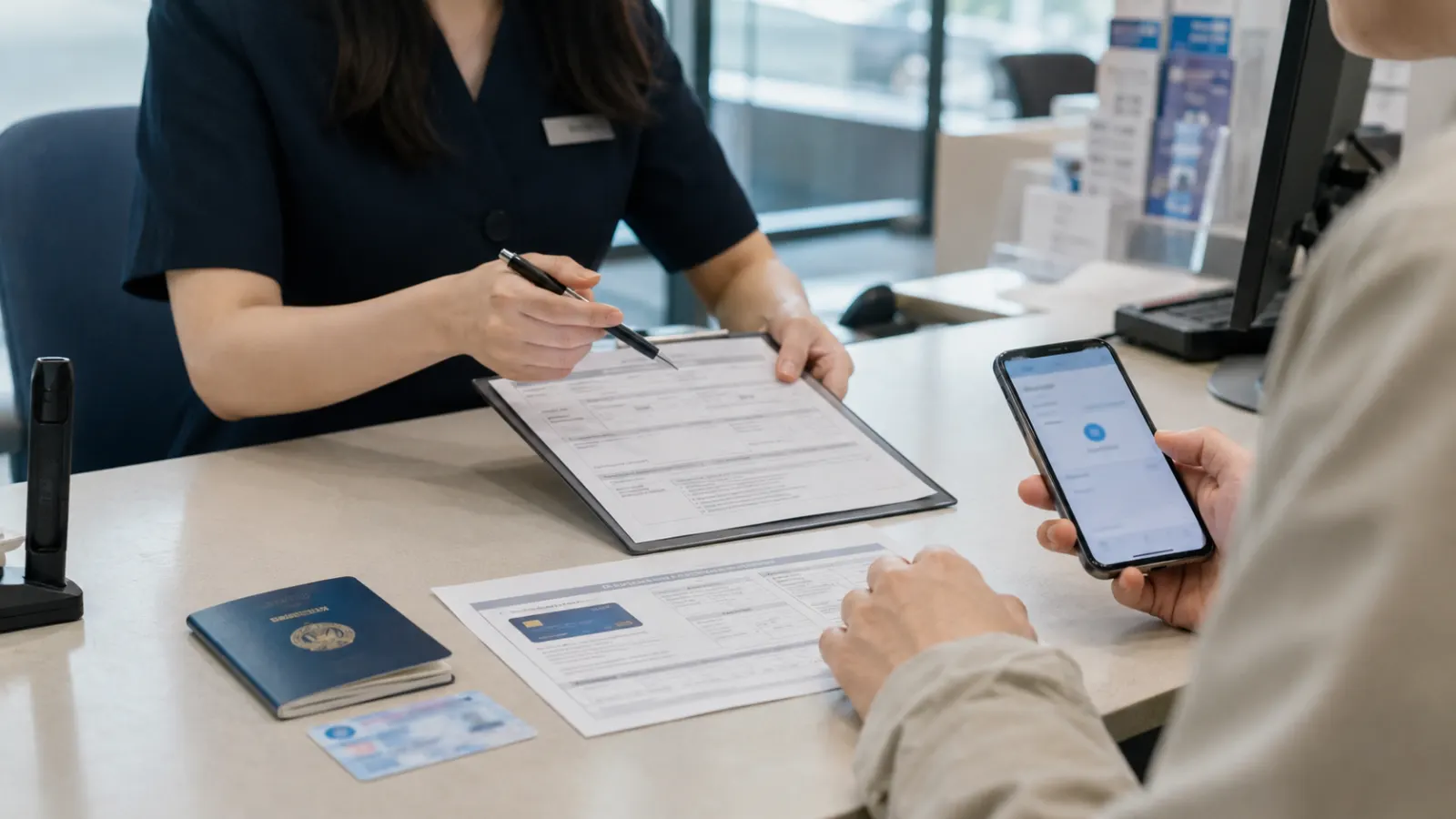
Requirements can differ by bank, branch, visa type, and staff judgment. Still, most foreigners should prepare more than the minimum. Showing up with extra documents is less annoying than visiting the bank twice.
Commonly useful documents include:
- Passport
- Foreigner residence card, if you have one
- Korean mobile phone number
- Proof of local address, such as a lease contract or housing confirmation
- Student ID or certificate of enrollment, if you are a student
- Employment contract or certificate of employment, if you are working
- Business registration or income-related documents, if relevant
- Home country tax or identification number, if requested
A mistake many newcomers make is assuming that a passport alone is enough. Sometimes it may be enough for limited services, but for a practical daily-life account, a residence card and local phone number are often much more helpful.
The phone number problem
One of the most frustrating parts of banking in Korea is the relationship between your bank account and your phone number.
You may hear two opposite answers: “You need a Korean phone number to open a bank account” and “You need a bank account to get a proper phone plan.” Both can feel true depending on the branch, phone carrier, plan type, and your documents.
This is why foreigners often get stuck in a loop. A prepaid SIM may give you data and a Korean number, but it may not support full identity verification under your legal name. A bank may issue an account but limit online banking until your verified phone number is connected. A phone carrier may ask for a local payment method before giving you a better postpaid plan.
The practical solution is to ask very specific questions. Do not only ask, “Can I get a Korean number?” Ask, “Can this number be used for identity verification under my legal name?” At the bank, ask, “Can I use this number for mobile banking and authentication?” Those are different questions.
Name matching is more important than foreigners expect
Korean digital systems are often strict about names. Your passport, residence card, telecom account, bank account, and card application should match as closely as possible.
Problems can happen when one place enters your name as “JANE MARIA SMITH,” another as “SMITH JANE MARIA,” and another as “JANE SMITH.” Middle names, hyphens, long names, spaces, and different ordering can cause failed verification even when your documents are valid.
Before leaving the bank or phone shop, check how your name has been entered. It may feel overly detailed, but it can save hours later when you try to use banking apps, payment apps, online shopping, or identity verification services.
What kind of account should you ask for?
Most foreigners opening their first account in Korea need a basic deposit account with a debit-style card, often called a check card. A check card is linked to your account and is widely used for daily spending.
A credit card is different. Foreigners may be able to apply for one, but approval can depend on income, visa status, length of stay, credit history, employer, and bank policy. If you have just arrived, do not assume you can get a Korean credit card immediately.
For most newcomers, the priority order should be simple:
- Open a basic bank account.
- Get a check card.
- Activate mobile banking.
- Confirm transfer limits.
- Connect your phone number correctly.
- Consider credit cards only after your income and local history are clearer.
The account itself is only the first step. Mobile banking and transfer limits matter just as much.
Why your account may have limits
Some foreigners are surprised when they open an account but cannot transfer large amounts, use full mobile banking, or send money overseas easily. This is often related to risk controls, documentation, and the bank’s internal rules.
A new account may have lower transfer limits at first. The bank may ask for proof of employment, salary, tuition payment, rental contract, or other purpose documents before raising limits. International remittance may require additional checks, especially if the amount is large or the source of funds is unclear.
This can be annoying, but it is better to know before you depend on the account. If you need to pay a housing deposit, tuition, business cost, or large transfer, ask about limits before the deadline.
Students, workers, and freelancers have different needs
A student usually needs an account for tuition refunds, scholarships, part-time wages, daily spending, and rent. A university-related bank branch may be easier because staff are used to foreign students.
An employee needs salary deposits, mobile banking, rent transfers, debit card use, and possibly overseas remittance. If your employer has a main bank, opening an account there may make salary processing easier.
A freelancer or small business owner should be more careful. Personal banking and business-related income can become complicated if you are receiving payments from Korea and overseas. You may need to think about tax reporting, invoicing, foreign exchange, and whether a separate business account is appropriate.
A tourist, by contrast, usually should not spend too much energy trying to open a local account unless there is a specific reason. For short stays, foreign cards, cash, travel cards, and global payment services are usually more realistic.
Choosing a bank branch
In Korea, the branch matters. The same bank can feel easy at one branch and difficult at another. Branches near universities, foreigner-heavy neighborhoods, business districts, or immigration-related areas may be more familiar with foreign documents.
If possible, choose a branch where staff regularly handle foreign customers. Bring documents in printed form, not only on your phone. Be clear about your purpose: studying, salary, rent, living expenses, or long-term residence.
If one branch says no, it does not always mean every bank will say no. It may mean that branch is cautious, unfamiliar with your case, or missing a document they want.
What to check before leaving the bank
Do not leave the branch as soon as the account is opened. Check the practical details while you are still there. Make sure you know:
- Whether your check card is active
- Whether mobile banking is available
- Your daily transfer limit
- Whether your phone number is connected correctly
- Whether overseas remittance is possible
- Whether you can receive salary or refunds
- How to reset your password if verification fails
- Whether your name format matches your phone record
This is the difference between technically having an account and having an account that actually works in daily life.
A realistic way to approach Korean banking
Opening a Korean bank account is not impossible, but it is rarely as casual as opening an app and entering a card number. Korea’s banking system is built around real-name verification, local documentation, phone authentication, and careful fraud prevention.
For short-term visitors, a Korean account is usually unnecessary. For students and workers, it is worth setting up properly as soon as your residence card and phone situation are ready. For long-term residents, your bank account, phone number, and legal-name records should be treated as one connected system.
The smartest move is to prepare more documents than you think you need, keep your name consistent, ask about transfer limits early, and choose a branch used to foreign customers. A little preparation at the beginning can prevent a lot of small banking problems later.
Quick Summary
- A Korean bank account is useful for salary, rent, refunds, local cards, online shopping, and daily transfers.
- Foreigners should prepare a passport, residence card, Korean phone number, local address proof, and purpose-related documents.
- Phone number verification and name matching are common reasons banking becomes frustrating.
- Before leaving the branch, check mobile banking, card activation, transfer limits, phone connection, and remittance options.