Korean Phone Plans for Foreigners: Prepaid, Postpaid, eSIM, and Verification
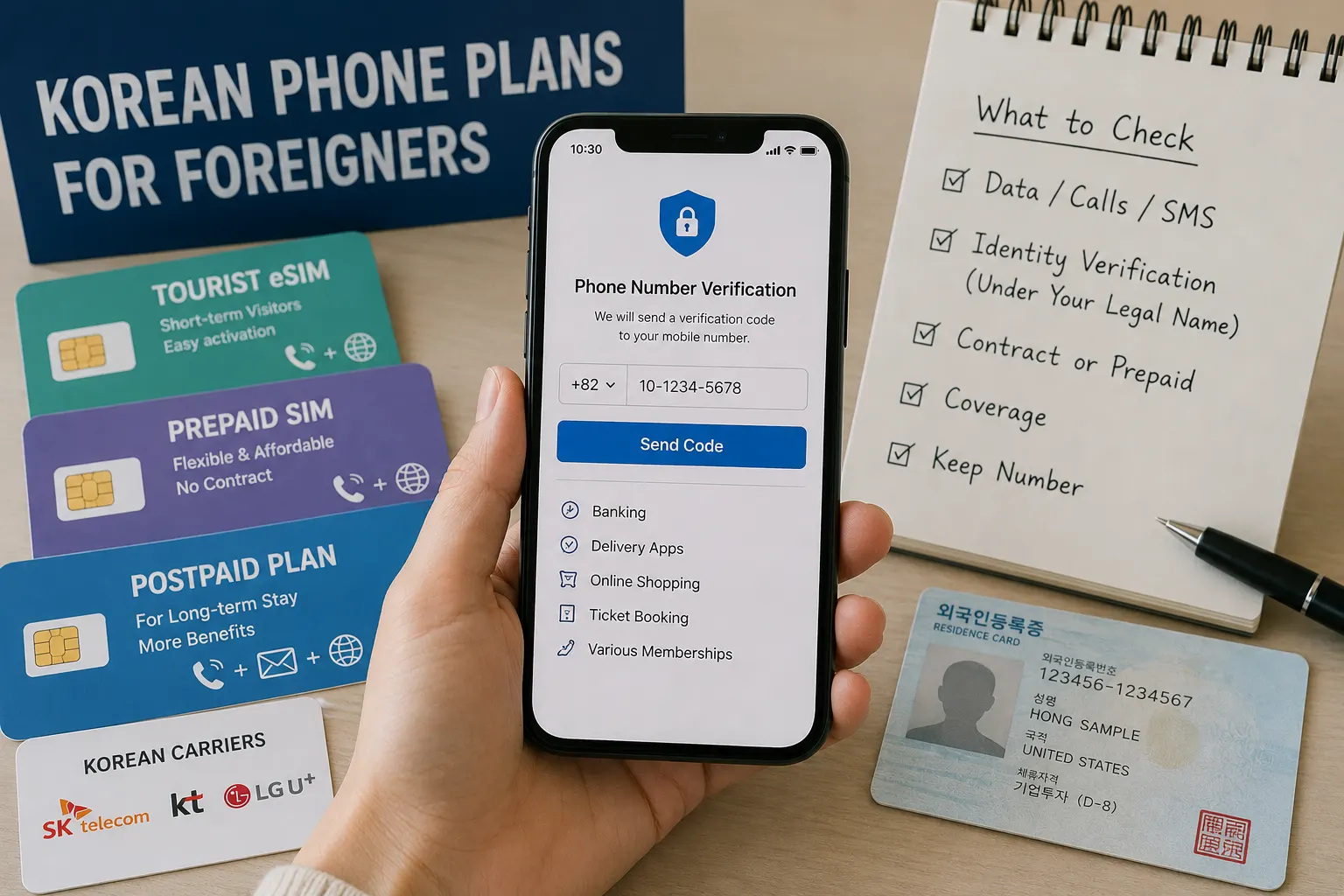
A phone number in Korea is not just a way to call people. For many foreigners, it becomes the key to banking, delivery apps, online shopping, hospital reservations, ticketing, apartment contracts, and identity verification. That is why choosing a Korean phone plan can feel more important than expected.
The confusing part is that not every Korean SIM, eSIM, or phone number works the same way. A tourist data eSIM may be perfect for maps and messaging, but useless when an app asks for identity verification. A long-term resident may pay for a cheap prepaid plan, then discover that some services still want a phone number registered under their legal name.
Why phone plans in Korea are confusing for foreigners
In many countries, a mobile plan is mainly about data, calls, price, and coverage. In Korea, those things matter, but there is another layer: verification.
A Korean phone number is often used to confirm your identity. When you sign up for local apps, reset passwords, verify bank access, book certain services, or use payment systems, the platform may check whether the phone number is connected to your registered legal name.
This is where foreigners run into trouble. You may have a working Korean number, but the app may still reject you because:
- The number is not registered under your legal name.
- Your name format does not match your bank, card, or residence record.
- The SIM is data-only and cannot receive normal texts or calls.
- The plan is designed for short-term travel, not full local verification.
- The platform requires a Korean residence record or domestic identity check.
This does not mean the phone plan is bad. It means the plan may be good for internet access but weak for Korea’s identity-based digital systems.
The main options: tourist eSIM, prepaid SIM, and postpaid plan
Foreigners usually choose between three broad options. The best choice depends on whether you are visiting, studying, working, or living in Korea.
A tourist eSIM is the easiest option for short trips. You can often buy it before arrival, scan a QR code, and get mobile data quickly. It is convenient for maps, translation, messaging, ride-hailing, and browsing. The downside is that many travel eSIMs are data-only. Even when they provide a number, it may not work for deeper identity verification.
A prepaid SIM is common among students, language school students, working holiday visitors, and people who have just arrived. It can be cheaper than a tourist plan and may include a Korean number, calls, texts, and data. Some prepaid plans are useful during the waiting period before your foreigner residence card is ready. However, prepaid plans vary a lot. Some work well for everyday communication, while others may still be limited for app verification.
A postpaid plan is closer to what many Korean residents use. It is usually billed monthly and connected more formally to your identity. For long-term residents, this can be the most stable option for banking, payment apps, delivery apps, and online accounts. The trade-off is that setup may require more documents, a local bank account, or a residence card depending on the carrier and plan.
What tourists should choose
For tourists, the mistake is overthinking the system. You usually do not need to become fully integrated into Korea’s mobile identity system for a one-week or two-week trip. A tourist should mainly care about:
- Reliable data for maps, translation, and messaging
- Whether the plan supports hotspot sharing
- Whether voice calls are needed for restaurants, hotels, or tours
- Airport pickup versus instant eSIM activation
- Coverage outside Seoul if visiting regional cities
For most short stays, a data eSIM or airport SIM is enough. The main limitation is not internet access. The limitation is that some Korean apps may not accept you as a fully verified local user.
That is why a tourist should not assume a Korean number will unlock every app. Food delivery, local booking platforms, concert ticketing, and shopping apps may still ask for verification that a short-term SIM cannot provide. In those cases, it is often easier to use hotel assistance, global booking platforms, direct website reservations, or services that clearly support foreign cards and foreign users.
What students and new residents should think about
Students and new residents have a different problem: the first few weeks. You may need a phone number before you finish all local paperwork, but the strongest phone setup may require that paperwork first.
During this period, a prepaid SIM can be useful. It gives you a Korean number, helps with basic communication, and makes daily life easier while you wait for residence registration, banking, or school paperwork. But it is worth asking one question before buying: “Can this number be used for identity verification under my legal name?”
Do not only ask about data size. Ask whether the plan supports SMS, calls, and verification. Also check whether you can later change from prepaid to a more stable plan without losing your number. Losing a number can be annoying because Korean services often use it for login, password recovery, bank alerts, and app security.
Name consistency matters. If your passport, residence card, telecom account, bank account, and school record show your name in different orders or spellings, verification can become frustrating. This is especially common for people with middle names, hyphenated names, long names, or names that are entered differently by different offices.
What long-term residents should prioritize
For anyone staying in Korea for a year or more, the cheapest plan is not always the best plan. A slightly more stable phone setup can save time across banking, delivery, shopping, hospital bookings, tax-related services, and government platforms.
Long-term residents should prioritize:
- A number registered under the same legal name used by immigration and banking
- SMS and call support, not only data
- Reliable customer service when verification fails
- Easy plan changes if your data needs increase
- A payment method that will not suddenly fail
- The ability to keep the same number when changing plans or carriers
This is also where Korea differs from many countries. In some places, changing phone numbers is a minor inconvenience. In Korea, it can disrupt many connected services. Your phone number may be tied to banking, delivery apps, shopping accounts, payment services, hospital apps, used goods platforms, and school or workplace systems.
If you are planning to stay long term, treat your phone number almost like a digital address. Choose it carefully, keep it active, and avoid changing it unless necessary.
Prepaid versus postpaid: which is better?
Prepaid is better when you need flexibility. It is useful for short stays, early arrival periods, students who are not sure how long they will stay, or anyone who wants to avoid a contract. It can also be easier to start with fewer requirements.
Postpaid is better when you want stability. It usually fits people with a longer visa, local bank account, regular monthly billing, and a need to use Korean services more deeply. If you plan to use Korean banking, delivery apps, online shopping, and verification-heavy services often, postpaid may feel smoother once it is set up.
The practical answer is not “prepaid is bad” or “postpaid is always better.” The real question is how much of Korean digital life you need to access.
For a traveler, prepaid or eSIM is enough. For a semester student, prepaid may be enough at first, but verification support matters. For a worker or long-term resident, a properly registered number becomes much more valuable than a cheap data package.
Common mistakes to avoid
The biggest mistake is buying only by data size. A plan with huge data may still be frustrating if it cannot receive verification texts or connect to your legal name.
Another mistake is assuming that “Korean number” means “full Korean verification.” These are not always the same thing. A number can work for calls and texts but still fail in certain apps.
A third mistake is changing phone numbers too casually. Once you start using a number for banks, apps, deliveries, and accounts, changing it can create a long cleanup job.
Finally, do not ignore your exact name format. When opening accounts, try to keep your name as consistent as possible across telecom, bank, immigration, school, and workplace records. In Korea, small differences can cause big digital problems.
How to choose the right plan
Use your stay length as the starting point. If you are staying less than one month, choose convenience. A tourist eSIM or airport SIM is usually enough. If you are staying one to six months, choose flexibility. A prepaid SIM with calls, texts, and a Korean number may be more useful than a data-only eSIM.
If you are staying six months to one year, choose verification readiness. Ask whether the number can be registered under your legal name and used for local services.
If you are staying longer than one year, choose stability. A well-registered phone number, local bank account, and consistent identity records will matter more than saving a small amount each month.
The best Korean phone plan is not simply the cheapest or fastest one. It is the one that matches your real life in Korea: tourist, student, worker, freelancer, spouse, entrepreneur, or long-term resident.
Quick Summary
- A Korean phone number is often used for identity verification, not just calls and data.
- Tourist eSIMs are convenient, but many do not unlock local apps that require full verification.
- Students and new residents should check whether prepaid SIMs support SMS, calls, and legal-name registration.
- Long-term residents should prioritize a stable number connected consistently to banking, immigration, and daily Korean services.