Moving to South Korea with a dog or cat requires more preparation than booking a pet-friendly flight. Your animal must meet Korean import quarantine requirements, and missing documentation can lead to detention or return at the airport.
Dogs and cats entering South Korea must undergo animal quarantine and generally require an official health or quarantine certificate issued by the exporting country's competent authority. Additional requirements can involve microchip identification and rabies antibody testing, depending on the animal's age and country of origin.
Here is how to prepare the documents, distinguish airline rules from Korean quarantine requirements, and avoid problems on arrival.
Who Sets the Rules for Bringing Pets to Korea?
South Korea's Animal and Plant Quarantine Agency (APQA) administers animal import quarantine.
The Korean term is:
동물검역 (dongmul geomyeok)
This means animal quarantine.
The official agency website is:
Incheon International Airport also publishes an English-language animal quarantine guide.
The airport guidance explains that travelers bringing animals must declare them and undergo the appropriate quarantine process.
The requirements apply to pets entering Korea, not just animals intended for commercial sale.
However, the specific conditions differ by species, origin, and health documentation.
This article concerns ordinary companion dogs and cats. Other animals can have different requirements.
What Documents Do You Need?
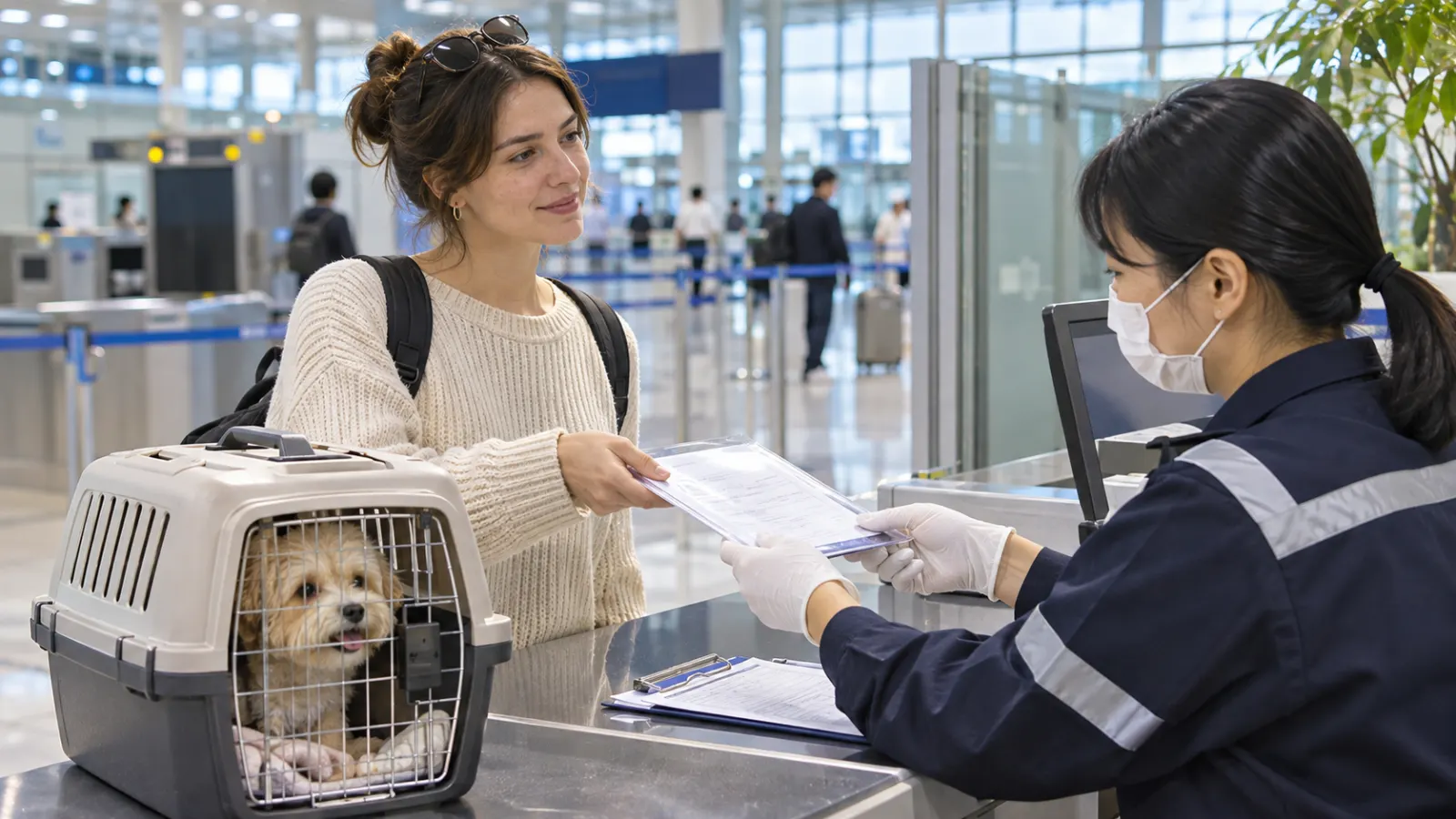
The airport's official quarantine guide identifies an official quarantine certificate from the exporting country as a core requirement.
This document must be issued by the government authority responsible for animal quarantine in the country of departure.
A private veterinarian's vaccination record alone should not be assumed to satisfy the official certificate requirement.
Core Preparation Checklist
Item | Why it matters |
|---|---|
Official quarantine certificate | Required for the import inspection |
Microchip identification | Helps establish the animal's identity |
Rabies vaccination information | Relevant to rabies-related entry requirements |
Rabies antibody test results | May be required depending on origin and age |
Airline pet reservation | Required separately under the airline's transport rules |
Owner's travel documents | Help connect the animal with the accompanying traveler |
The exact information required on the certificate must be confirmed with APQA and the exporting country's authority.
Do not assume that a generic international pet health certificate contains every required entry.
Does Your Dog or Cat Need a Microchip?
Microchip identification is an important part of Korea's pet import requirements.
The animal's identity must be consistent across its supporting records.
Before arranging laboratory testing or obtaining a final health certificate, ask the exporting authority which microchip standard Korea accepts.
If the animal has already been microchipped, confirm that the chip can be read and that its number matches the documents.
A mismatch can create problems during quarantine inspection.
For example, an antibody test report containing a different identification number may not clearly establish that the result belongs to the animal being imported.
Is Rabies Antibody Testing Required?
Korea applies rabies-related import requirements that depend on the animal's circumstances.
A rabies antibody test measures the level of antibodies against rabies in the animal's blood.
However, travelers should not assume that every dog and cat requires the same test.
The applicable rules can depend on:
Country of origin
Animal's age
Rabies-related country classification
Vaccination history
Applicable quarantine exemptions
APQA provides the authoritative requirements for each situation.
Why Country of Origin Matters
An animal traveling from a country or region recognized under particular rabies-related conditions may face different requirements from an animal traveling from another country.
Do not apply rules intended for one country to another.
If you are moving from the United States, United Kingdom, Australia, Japan, or another country, confirm the requirements for that specific origin.
The same applies if your pet has recently lived in more than one country.
What About Young Puppies and Kittens?
Age can affect vaccination and antibody-testing requirements.
Do not assume that an exemption from one test means an animal can enter Korea without documentation or inspection.
Ask APQA and the exporting authority about the animal's exact age on the intended arrival date.
How to Prepare Before Your Flight
Start with the destination-country quarantine requirements, not the airline booking.
Step 1: Identify Your Pet's Import Category
Confirm the animal's species, age, country of origin, and travel history.
These details help determine the relevant quarantine requirements.
Step 2: Contact the Exporting Country's Official Authority
Ask which government body issues the quarantine certificate accepted for entry into South Korea.
The responsible agency differs by country.
Some countries require an accredited veterinarian to complete an examination before a government authority endorses the certificate.
Do not assume that your regular veterinarian can issue the final official document independently.
Step 3: Verify Microchip and Rabies Requirements
Check the microchip information, vaccination documentation, and whether antibody testing is required.
If a laboratory test is necessary, allow sufficient time for sample collection, laboratory processing, and any applicable validity conditions.
Do not book an irreversible travel itinerary before confirming these requirements.
Step 4: Obtain the Official Certificate
Arrange the required inspection and official documentation through the exporting country's authorized process.
Check that names, dates, microchip numbers, and test information are consistent.
Step 5: Confirm Airline Acceptance
Ask the airline whether your animal can travel on the selected flight.
Airlines may impose restrictions involving carrier dimensions, weight, breed, aircraft type, and the number of animals accepted.
A pet meeting Korean quarantine requirements is not automatically accepted for carriage by every airline.
Cabin Travel vs. Checked Animal Transport
Airline transportation and government quarantine are separate decisions.
Some animals may be accepted in the passenger cabin under an airline's conditions.
Others may need to travel through a different transport arrangement.
The airline determines its own carriage requirements, subject to applicable aviation rules.
Korean quarantine authorities determine whether the animal satisfies entry requirements.
Therefore, you need approval from both sides.
Example
Suppose your airline confirms that your small dog can travel in the cabin.
That approval does not replace the official quarantine certificate.
Likewise, having all Korean quarantine documents does not guarantee that the airline has an available pet space on your flight.
Confirm both before departure.
What Happens When You Arrive in Korea?
Incheon International Airport's official guidance identifies the following general process.
Step 1: Declare the Animal
Travelers carrying animals must complete the relevant declaration procedure.
Follow the instructions provided by the airline and airport authorities.
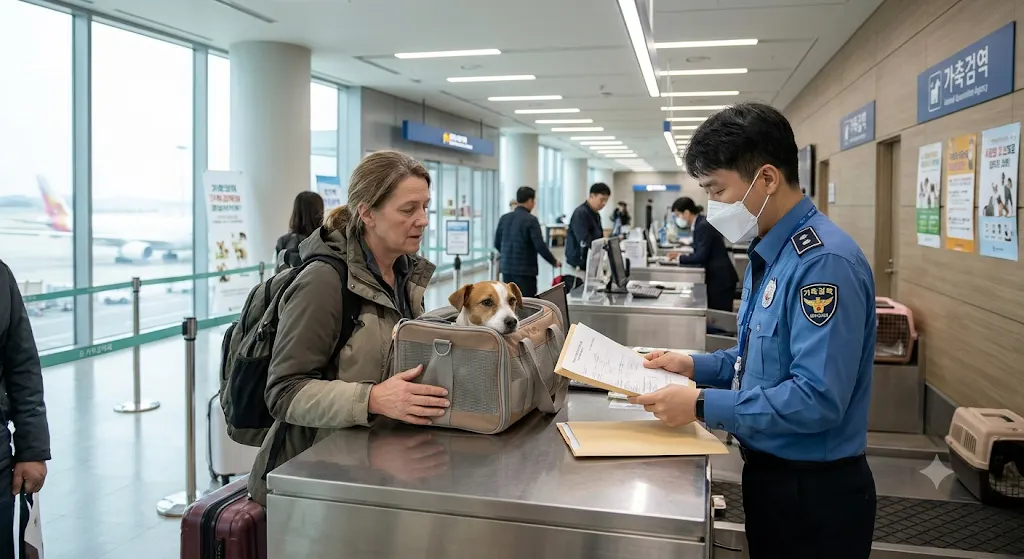
Step 2: Visit Animal Quarantine
Before completing the applicable customs arrival process, present the animal and its official documentation to the quarantine officer.
Do not simply proceed through the airport without reporting the animal.
Step 3: Submit the Certificate
The officer reviews the quarantine certificate and other relevant information.
Additional checks may be necessary depending on the animal's circumstances.
Step 4: Follow the Inspection Decision
If the requirements are satisfied, the animal may be released following the applicable inspection.
If documents are missing or do not meet the requirements, the animal may be detained or returned.
The airport explicitly warns that pets without the required quarantine certificate can be subject to return.
The outcome depends on the specific deficiency and applicable quarantine rules.
Does Your Pet Have to Stay in Quarantine?
Do not assume that every pet entering Korea must remain in a quarantine facility for a fixed number of days.
The result depends on whether the animal satisfies the applicable entry conditions and whether further inspection is required.
An animal with complete, acceptable documentation may follow a different process from one with missing or inconsistent records.
If detention is required, additional time, handling, and costs may be involved.
The official airport guidance does not establish one universal quarantine duration for all dogs and cats.
Contact APQA for your animal's specific circumstances.
What If Your Documents Are Incomplete?
This is one of the most serious travel risks.
According to the airport's official guidance, an animal without the required quarantine certificate may be returned.
An animal whose certificate does not satisfy the requirements may be detained.
Do not assume that you can resolve every missing document after landing.
Some requirements must be completed in the exporting country before departure.
If you discover a problem before traveling, contact the exporting authority and APQA immediately.
Postponing the flight may be safer and less costly than arriving with an animal that cannot be released.
Special Cases: Australia, Malaysia, and Other Origins
Incheon International Airport specifically notes that additional documentation is required for animals arriving from Australia and Malaysia.
This demonstrates why a general international pet travel checklist is insufficient.
A country-specific requirement may apply even when the animal has a vaccination record and official health certificate.
Always check the latest APQA requirements for the exact exporting country.
Do not rely solely on advice from another pet owner who traveled from a different country.
What About Other Pets?
Rabbits, hamsters, ferrets, and other animals are not automatically covered by the same rules as dogs and cats.
The official airport guide lists other pets separately and identifies official quarantine certification requirements.
Some species may also be subject to additional import, wildlife, or animal-health controls.
Before transporting an animal other than a dog or cat, contact the relevant authority to determine the correct import category.
Common Mistakes to Avoid
Booking the Flight Before Checking Quarantine Requirements
Some documents and tests require advance preparation.
Assuming a Vaccination Booklet Is Enough
Korea requires appropriate official quarantine documentation.
Ignoring Microchip Number Consistency
The animal's identification should match the supporting records.
Assuming Airline Approval Means Import Approval
Transport acceptance and quarantine clearance are separate.
Assuming All Countries Have the Same Rabies Rules
Requirements depend on origin and other circumstances.
Failing to Declare the Animal
Animals entering Korea are subject to quarantine inspection.
A Final Checklist Before Traveling
At least several weeks before your intended departure, begin confirming the requirements with the relevant authorities.
Before flying, verify:
Your pet's eligibility for import from the country of origin.
The applicable microchip requirements.
Rabies vaccination and antibody-testing conditions.
The official exporting-country quarantine certificate.
Any country-specific supporting documents.
Airline approval and transport arrangements.
The arrival airport's animal quarantine procedure.
A contingency plan if documents are rejected or travel is delayed.
The official Incheon Airport quarantine guidance and APQA information were checked on November 15, 2026. Individual import conditions must be confirmed for the animal's age, origin, and documentation before departure.
Quick Summary
Dogs and cats entering South Korea must undergo animal quarantine and generally require an official certificate from the exporting country's competent authority.
Microchip identification and rabies-related testing requirements depend on the animal's circumstances and origin.
Airline acceptance does not replace Korean import quarantine approval.
Missing or unacceptable documents can lead to detention or return, so confirm the requirements with APQA before booking travel.