Planning a wheelchair-accessible trip to South Korea requires more than checking whether an attraction has an elevator or accessible entrance. A destination may have an accessible parking area and restroom but still contain stairs, steep slopes, or restricted indoor spaces.
The best starting point is the Korea Tourism Organization's official Accessible Tourism portal, called 열린관광 모두의 여행. It provides information about accessible routes, facilities, parking, restrooms, and selected transportation options. However, travelers should confirm the specific route they intend to use before visiting.
Here is how to research an accessible destination, understand Korean accessibility descriptions, and identify potential barriers that ordinary travel guides may overlook.
Where to Find Wheelchair-Accessible Travel Information in Korea
The Korea Tourism Organization (KTO) operates a dedicated accessible tourism information service.
Its official website is:
https://access.visitkorea.or.kr/
The portal is known in Korean as:
열린관광 모두의 여행
This can be understood as "Open Tourism: Travel for Everyone."
The service provides information about destinations developed or documented through Korea's accessible tourism initiatives.
These initiatives address barriers that may affect wheelchair users, older visitors, families with strollers, and travelers with other accessibility requirements.
Unlike ordinary destination descriptions, the accessible tourism pages may provide information about specific facilities and routes.
For example, a destination profile may identify:
- Accessible parking areas
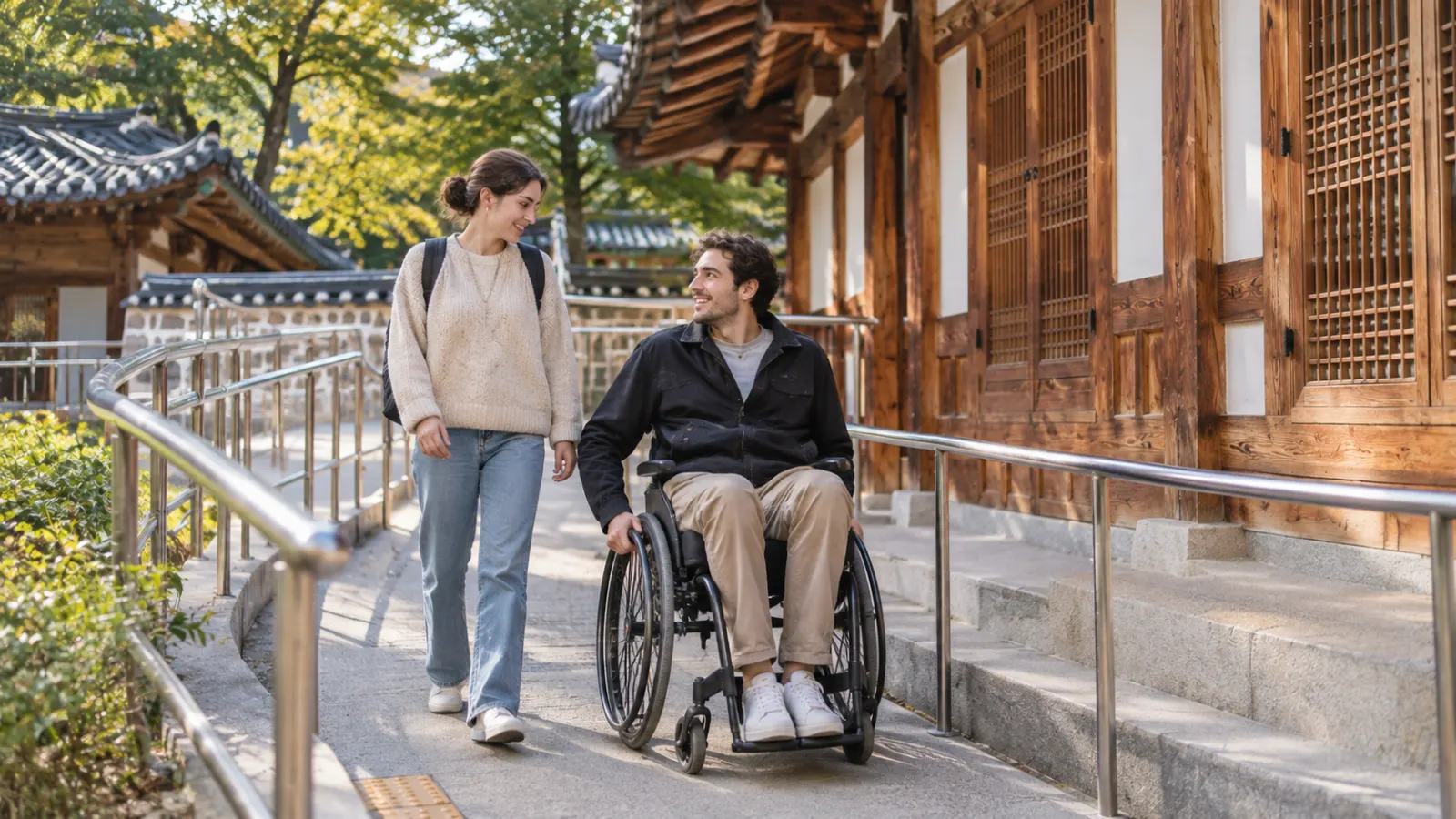
- Step-free walking routes
- Ramps and handrails
- Accessible restrooms
- Wheelchair rental facilities
- Rest areas
- Accessible exhibitions and experiences
- Regional transportation assistance
The availability of these features differs by location.
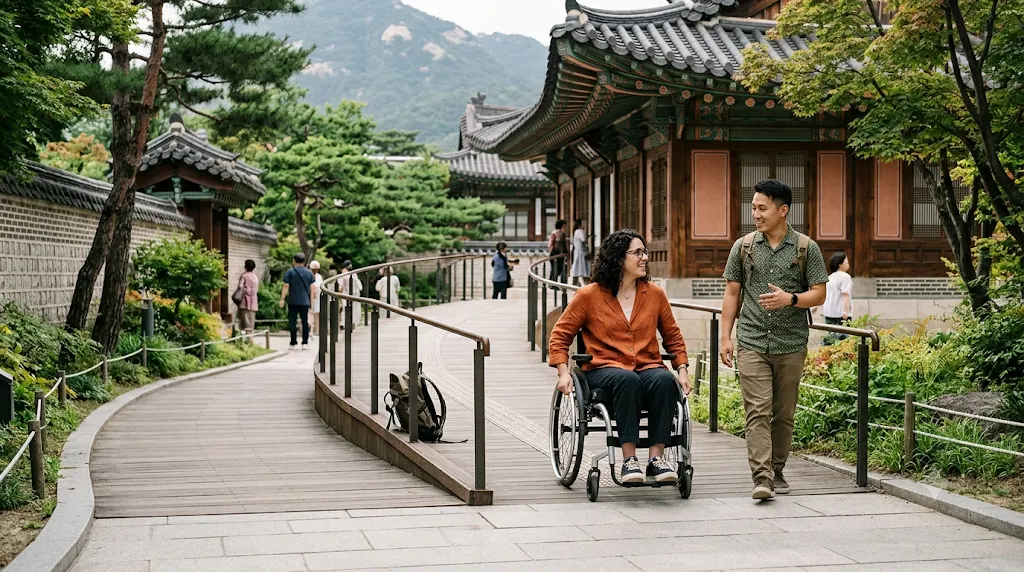
What Does an "Open Tourist Destination" Mean?
The Korean term 열린관광지 (yeollin gwangwangji) means "Open Tourist Destination."
It is used for attractions participating in an initiative to improve accessibility for people with different mobility and travel needs.
However, this designation should not be interpreted as a guarantee that every part of the destination is accessible.
A historic village may have a newly improved accessible walking route while individual traditional buildings remain difficult to enter.
A natural attraction may provide a wheelchair-accessible observation area without making the entire surrounding trail accessible.
The practical question is not simply whether the destination is labeled accessible.
It is whether the specific facilities and routes you want to use meet your requirements.
How to Check Accessibility Before Visiting
Follow a consistent process for each destination.
Step 1: Search the Official Accessible Tourism Portal
Open:
https://access.visitkorea.or.kr/
Look for the section called:
열린관광지
This contains information about designated open tourist destinations.
If you know the attraction's Korean name, use it when searching.
For example, searching a Korean destination name may produce more specific information than searching only its English translation.
Step 2: Open the Destination's Detailed Profile
Look for the heading:
무장애 관광정보
This means "Barrier-Free Tourism Information."
A detailed profile may include maps and descriptions of accessibility improvements.
Pay particular attention to information about:
- The main entrance
- Walking routes
- Restrooms
- Parking
- Equipment rental
- Accessible transportation
- Restrictions affecting particular facilities
The information may be presented in Korean, so a translation tool can be helpful.
However, automatically translated descriptions may not fully explain technical accessibility limitations.
Step 3: Check the Entire Route
Consider your journey as a connected sequence.
For example:
Parking area → Main entrance → Ticket counter → Exhibition space → Restroom → Exit
An attraction is not necessarily suitable for your visit simply because the exhibition building has an elevator.
If the route between the entrance and building contains steps, steep surfaces, or inaccessible transport, the overall experience may still be difficult.
Check every critical section rather than relying on a general accessibility icon.
Step 4: Contact the Attraction
When the published information does not answer an essential question, contact the attraction directly.
Ask about your actual mobility needs rather than requesting a general accessibility confirmation.
For example, a manual wheelchair user may have different concerns from someone using a large powered wheelchair.
Information about slopes, doorway widths, elevator dimensions, and temporary closures can be particularly important.
Example: A Destination With Detailed Accessibility Information
The Korea Tourism Organization provides a detailed accessible tourism profile for Kim You-jeong Literature Village in Chuncheon.
The village is known in Korean as 김유정문학촌.
Its official accessible tourism profile was updated on August 27, 2026.
The profile describes several accessibility improvements.
These include:
- Improved walking routes
- Accessible parking
- Ramps and handrails
- Accessible restrooms
- Wheelchair and stroller rental facilities
- Wheelchair spaces in a media room
- Audio and tactile interpretation materials
This level of information is useful because it describes actual facilities rather than simply assigning the destination an accessible label.
However, the same profile also identifies an alternative entrance arrangement for a media facility where a stairway affects the ordinary route.
That detail illustrates why travelers should read the full accessibility description.
A venue can provide wheelchair spaces while still requiring visitors to use a different entrance.
If you need that route, confirm the arrangement before arrival.
Why an Accessible Attraction May Still Have Inaccessible Areas
Korea has many historic sites, temples, mountain attractions, and traditional buildings.
Their physical layouts can create accessibility limitations even when improvements have been introduced.
Bulgapsa Tourist Area in Yeonggwang provides a useful example.
According to the Korea Tourism Organization's official Bulgapsa accessibility profile, the tourist area includes accessible parking, an accessible restroom, and improved walking routes.
However, the same guide identifies limitations on wheelchair access to parts of the temple and certain indoor facilities.
This means a traveler may be able to enjoy the surrounding grounds without being able to enter every building.
The lesson applies to other heritage destinations as well.
When a site is described as accessible, confirm exactly which spaces are included.
Understanding Korean Accessibility Terms
Several Korean words can help you interpret official tourism information.
| Korean | English meaning |
|---|---|
| 무장애 관광 | Barrier-free tourism |
| 열린관광지 | Open tourist destination |
| 휠체어 접근 가능 | Wheelchair accessible |
| 장애인 화장실 | Accessible restroom |
| 경사로 | Ramp |
| 승강기 | Elevator or lift |
| 장애인 주차구역 | Accessible parking space |
| 휠체어 대여 | Wheelchair rental |
| 이동지원센터 | Mobility assistance center |
| 계단 | Stairs |
| 단차 | Level difference or step |
| 우회로 | Alternative route or detour |
These terms can help you review Korean maps, facility descriptions, and signs.
One important term is 단차 (dancha).
It refers to a difference in floor level.
A small step may not look important in an attraction photograph, but it can make a doorway inaccessible to someone who cannot cross it independently.
When reviewing a destination, look for descriptions that specifically address level differences and ramps.
What About Accessible Transportation?
Finding an accessible attraction is only part of the journey.
You also need a suitable way to reach it.
The accessible tourism portal sometimes includes information about regional mobility assistance services.
These may be described as:
장애인 콜택시
This means disability-accessible call taxi.
Some services operate specially adapted vehicles.
However, registration and eligibility requirements may differ by municipality and service provider.
Foreign visitors should not assume that a local mobility service will accept bookings without advance registration or supporting documentation.
When planning transportation, confirm:
- Whether the service accepts foreign visitors.
- Whether advance registration is required.
- Whether your mobility device is supported.
- Whether you can travel between the intended locations.
- Whether return transportation can be arranged.
A service being listed on a tourism website does not guarantee immediate vehicle availability.
Check the Last Part of Your Journey
Even if an accessible train or vehicle gets you to the general destination, the final route may create difficulties.
A railway station may be several streets away from the attraction.
The route might contain steep hills, uneven pavement, or road crossings without convenient curb ramps.
Before traveling, check how you will get from the transport stop to the actual accessible entrance.
If the attraction has multiple gates, ask which entrance is recommended for wheelchair access.
How to Ask About Wheelchair Access in Korean
Here are practical questions you can show to attraction staff.
휠체어로 입장할 수 있나요?
"Can I enter using a wheelchair?"
주차장에서 입구까지 계단이 없나요?
"Is there a step-free route from the parking area to the entrance?"
장애인 화장실이 있나요?
"Is there an accessible restroom?"
경사로가 많이 가파른가요?
"Are the ramps very steep?"
전동휠체어도 이용할 수 있나요?
"Can a powered wheelchair use the facility?"
엘리베이터가 있나요?
"Is there an elevator?"
접근 가능한 출입구가 따로 있나요?
"Is there a separate accessible entrance?"
These questions are more useful than asking only whether a place is "wheelchair-friendly."
A venue may sincerely consider itself accessible while being unaware of a limitation that matters for your particular mobility device.
What If the Official Information Is Incomplete?
Not every Korean attraction has a detailed accessible tourism profile.
If a destination is not listed, that does not automatically mean it is inaccessible.
It may simply mean that it has not been documented through the particular tourism program.
You can also consult the Korea Tourism Organization's English-language tourism information.
Some destination descriptions identify accessible entrances, restrooms, low-floor transportation, and wheelchair rental services.
Because facilities can change, confirm essential information with the attraction operator before traveling.
If you cannot verify a feature that is necessary for a safe visit, choose a destination where that requirement can be confirmed.
A Five-Point Accessibility Checklist
Before committing to a destination, check five essential areas.
1. Arrival
Can you reach the site through transportation you can actually use?
2. Entrance
Is there a step-free route from your arrival point to the main accessible entrance?
3. Main activity
Can you access the exhibition, viewpoint, trail, or experience you are visiting for?
4. Facilities
Are suitable restrooms and rest areas available?
5. Return journey
Can you leave the attraction using the same accessible transportation arrangements?
If one of these elements is uncertain, contact the operator before making a reservation or starting the journey.
This guide reflects Korea Tourism Organization accessibility information checked on November 10, 2026. Individual facilities, transportation services, and accessibility arrangements can change.
Quick Summary
- Use the Korea Tourism Organization's Accessible Tourism portal to research wheelchair-accessible destinations in South Korea.
- An Open Tourist Destination designation does not guarantee that every building, trail, or experience is accessible.
- Check the complete journey, including transportation, entrances, walking routes, restrooms, and return arrangements.
- Confirm essential accessibility features directly with the attraction operator before visiting.