How Year-End Tax Settlement Works for Foreign Workers in Korea
If you've worked in Korea past your first December, you've likely heard coworkers mention "yeonmal jeongsan" (연말정산), often with a mix of dread and hope depending on whether they expect a refund or a bill. For foreign employees, this year-end tax settlement process is often the most confusing part of Korean payroll, partly because it's unfamiliar, and partly because the deductions that apply to long-term Korean residents don't always apply the same way to foreigners.
Here's what year-end tax settlement actually is, how it affects foreign workers differently, and what to check before submitting yours.
What Year-End Tax Settlement Actually Does
Throughout the year, Korean employers withhold estimated income tax from each paycheck based on a standard withholding table. Year-end settlement, done every January and February for the previous year's income, reconciles that estimate against your actual tax liability once deductions, exemptions, and credits are applied.
If your employer withheld more than you actually owed, you get a refund, usually deposited with your February or March salary. If they withheld less, you owe the difference. This isn't optional or something you can skip, employers are required to run this process for essentially all employees, foreign or Korean, unless your situation falls under a separate filing category.
Why It's Different for Foreign Workers
Most of the deductions that meaningfully reduce a Korean resident's tax bill, mortgage interest, certain insurance premiums, dependents living in Korea, credit card usage thresholds, assume a domestic financial life that many foreign workers don't have.
- Dependent deductions usually require the dependent to be a Korean resident, so a spouse or child living abroad typically doesn't qualify the way one living in Korea would.
- Housing-related deductions, like for jeonse loan interest, generally require the lease to be registered under standard Korean housing law, something officetel or short-term housing arrangements don't always satisfy.
- Credit card usage deductions apply, but many foreign workers use significantly less domestic card spending than long-term residents, especially in their first year, reducing the practical benefit.
A common misunderstanding is assuming these deductions simply don't apply to foreigners at all. In most cases they legally can apply, but the qualifying conditions (Korean residency of dependents, proper lease registration, sufficient domestic spending) mean many foreign workers end up with a much simpler, deduction-light filing than long-term Korean resident colleagues.
The Flat Tax Rate Option for Certain Foreign Workers
One thing that surprises many foreign employees: Korea offers a flat 19% income tax rate option for eligible foreign workers, as an alternative to the standard progressive tax brackets.
- This option is generally available for a limited number of years from your first day of work in Korea, so it's most relevant to workers in their initial years of employment rather than long-term residents.
- It tends to benefit higher earners more, since Korea's progressive brackets rise above 19% at higher income levels, for lower or moderate incomes, the standard progressive system with deductions may actually result in a lower tax bill.
- You typically need to actively elect this option, it's not applied automatically, so it's worth calculating both scenarios, or asking your HR or a tax professional, before assuming the flat rate is better.
What You'll Actually Need to Submit
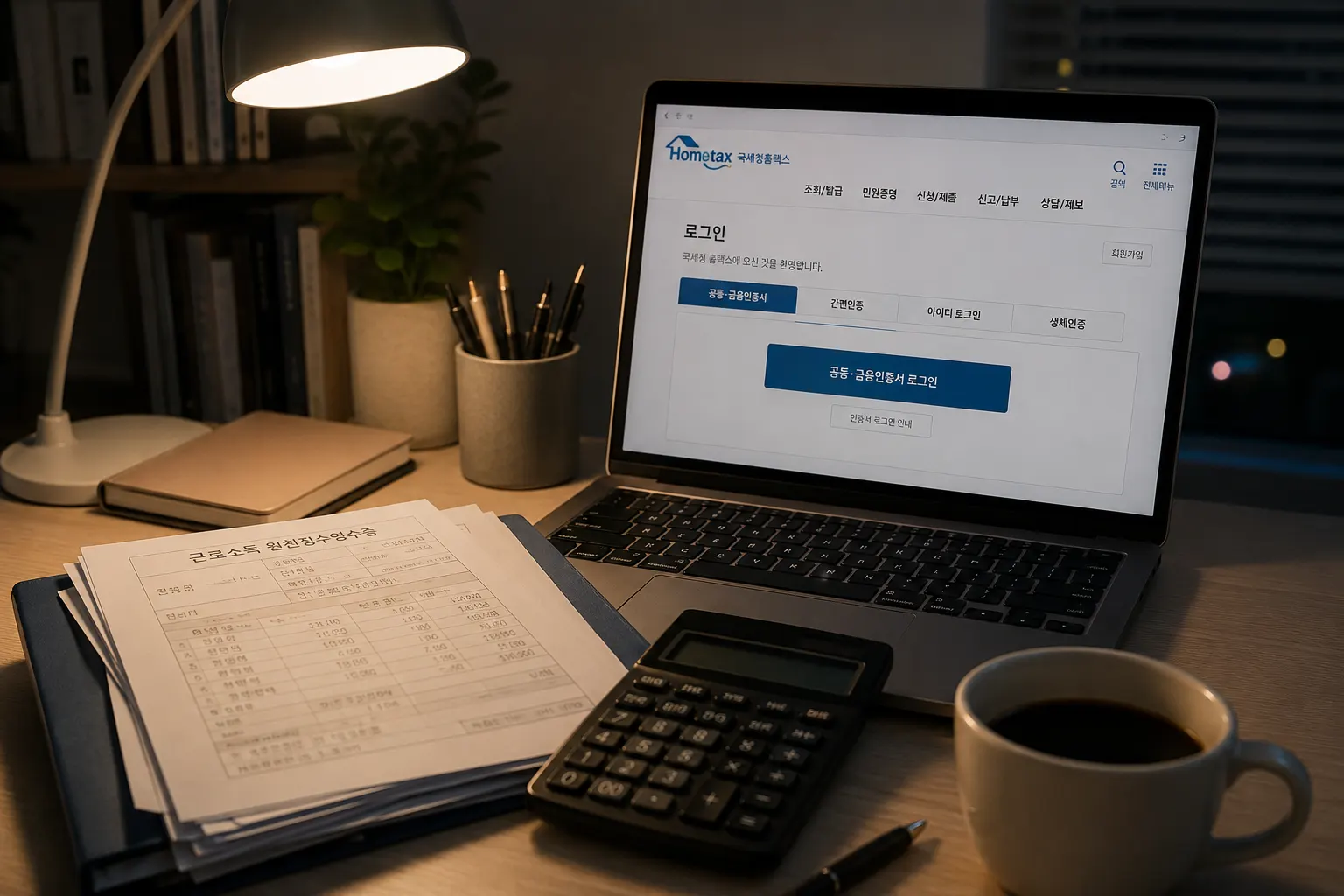
Most of the process happens through your employer's HR or payroll team, using Korea's Hometax system, but you're usually asked to provide:
- Proof of any insurance premiums paid personally (if not fully covered through payroll deductions)
- Documentation for dependents, if claiming any, including proof of Korean residency where required
- Bank account and credit/check card usage summaries, often pulled automatically through Hometax if your cards are registered under your ARC
- Any receipts for deductible expenses like certain medical costs or education expenses, if applicable to your situation
Many companies now handle much of this through an automated Hometax portal that pulls card and insurance data directly, reducing the manual paperwork compared to a few years ago, but foreign workers should still double check that all Korean-issued cards and accounts are properly linked under their name.
Common Mistakes Foreign Workers Make
- Assuming HR will catch everything automatically. Automated systems pull common data, but they don't always flag every deduction you might be eligible for, especially less common ones tied to specific circumstances.
- Missing the flat-rate election window. If you're eligible for the 19% flat rate and it would benefit you, you generally need to actively choose it rather than assume it's applied by default.
- Not keeping records of the first year's paperwork. If you change jobs mid-year, your new employer needs your withholding and income records from the previous employer to complete settlement correctly.
- Ignoring a settlement notice because it's in Korean. Refunds and additional tax due are both communicated through payroll or HR, and unpaid amounts can accumulate if ignored.
Quick Summary
- Year-end tax settlement (연말정산) reconciles taxes withheld throughout the year against your actual liability, typically processed by employers each January–February.
- Many standard Korean deductions require conditions, like dependents residing in Korea or registered leases, that foreign workers often don't meet in their early years.
- Eligible foreign workers can elect a flat 19% tax rate for a limited period, which can be beneficial for higher earners but isn't automatic and should be compared against the standard system.
- Keep records if you switch jobs mid-year, since your new employer needs prior income and withholding data to complete your settlement correctly.