How to Read a Korean Payslip: What Foreign Employees Should Know
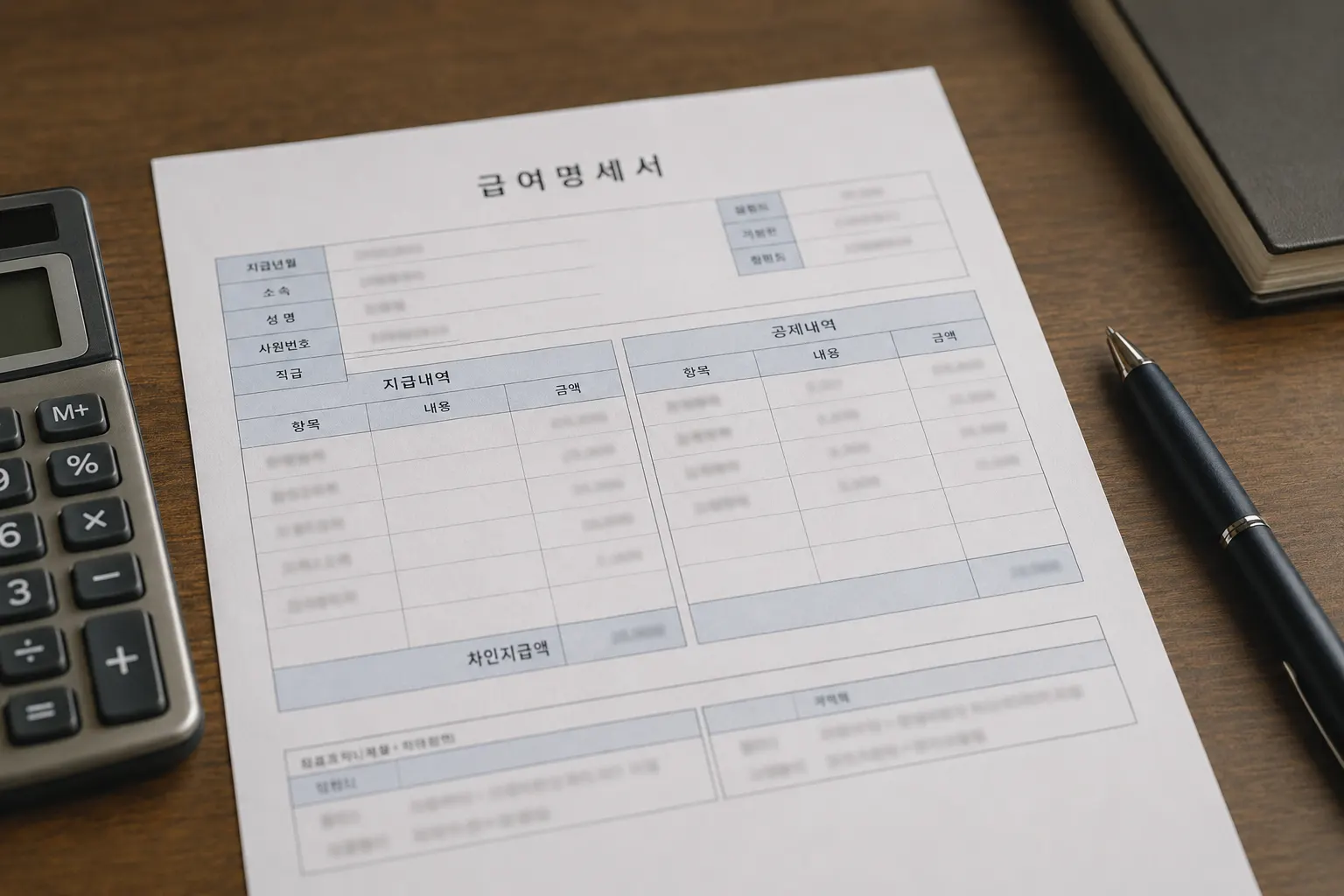
If you've opened your first Korean payslip and found a wall of Korean abbreviations, unfamiliar deduction categories, and a final deposit amount noticeably lower than your listed salary, you're not alone in finding it confusing. Korean payslips (급여명세서) follow a fairly standardized structure once you understand the terminology, but that structure isn't intuitive on first look, especially for foreign employees comparing it to payslip formats from home.
Here's how to actually read a Korean payslip, and what each major deduction actually represents.
The Basic Structure
Most Korean payslips are organized into two main sections: earnings (지급) and deductions (공제), with a final net pay figure (실수령액) at the bottom representing what actually lands in your bank account after all deductions.
- Base salary (기본급) is your core contracted salary before any additions or deductions.
- Additional allowances vary by company but commonly include things like meal allowance (식대), transportation allowance (교통비), and sometimes position-specific or overtime-related allowances, some of these carry different tax treatment than base salary, which is part of why understanding the breakdown matters for tax purposes.
- Overtime pay, if applicable, is generally itemized separately, calculated according to Korea's legal overtime pay requirements rather than folded into a single lump figure.
What Gets Deducted, and Why It's More Than Just Tax
The gap between your listed gross salary and your actual deposited net pay in Korea is usually larger than what many foreign employees expect, mainly because several mandatory deductions apply beyond income tax alone.
- Income tax (소득세) and local income tax (지방소득세), the local tax is generally calculated as a percentage of your national income tax, not a separate independent calculation.
- National Pension (국민연금), generally 4.5% of your salary as the employee's half of the total 9% contribution, subject to the reciprocity rules that determine whether foreign employees from certain countries are exempt.
- National Health Insurance (건강보험), along with an additional small long-term care insurance (장기요양보험) contribution calculated as a percentage of your health insurance premium, not your salary directly.
- Employment insurance (고용보험), a smaller deduction that funds unemployment benefits and related labor programs, generally applicable to most employees regardless of nationality.
A common misunderstanding is assuming these deductions are optional add-ons or company-specific benefits. In practice, National Pension, Health Insurance, and Employment Insurance are legally mandated payroll deductions for most standard employees, foreign or Korean, the only real variable for foreign employees is the pension reciprocity exception discussed elsewhere in Korea's foreign worker system.
Why Your Net Pay Might Look Different Some Months
- Year-end tax settlement adjustments, processed in January or February, can result in either a refund added to that month's pay or an additional deduction if you owed more tax than was withheld throughout the previous year.
- Bonus payments, if your contract includes them, are sometimes taxed at a different effective rate depending on how they're structured and paid, and can significantly change a given month's net pay figure compared to your regular baseline.
- National Pension contribution caps, adjusted periodically, mean very high earners may see their pension deduction plateau rather than scale linearly with salary increases beyond a certain point.
Common Abbreviations Worth Knowing
- 기본급 — base salary
- 직책수당 / 직무수당 — position or role-based allowance
- 상여금 — bonus
- 국민연금 / 건강보험 / 고용보험 — the three main mandatory insurance deductions
- 소득세 / 지방소득세 — national and local income tax
- 실수령액 — final net pay, the actual amount deposited
Recognizing these terms, even without full Korean fluency, makes reviewing your own payslip each month considerably easier than treating it as an opaque document to skim past.
What to Actually Check Each Month
- Confirm your base salary matches your contract, discrepancies do happen, particularly around raises, allowance changes, or contract renewals, and are easier to catch early than after several months have passed.
- Check that pension and insurance deductions align with what you expect, particularly relevant if you believe you qualify for a National Pension reciprocity exemption but see a full deduction applied anyway.
- Review any bonus or overtime calculations against your understanding of your contract terms, since these are more prone to calculation errors than straightforward base salary.
- Keep payslips accessible for future reference, useful for loan applications, visa renewals, or year-end tax settlement documentation, rather than only for immediate paycheck verification.
Common Mistakes Foreign Employees Make
- Not reviewing payslips at all, assuming the deposited amount is automatically correct without checking the breakdown against expectations.
- Confusing gross salary discussed during hiring with actual net pay, leading to budget surprises in the first month or two of employment before the actual deduction pattern becomes familiar.
- Not flagging discrepancies promptly. Payroll errors are usually easier to correct the same month they occur than after several pay cycles have passed.
- Overlooking the pension reciprocity exemption if eligible, assuming the standard deduction applies without confirming your specific country's status with HR or the National Pension Service.
Quick Summary
- Korean payslips separate earnings and deductions into distinct sections, with a final net pay figure that's often meaningfully lower than the gross salary discussed during hiring.
- Mandatory deductions include income tax, National Pension, National Health Insurance, and Employment Insurance, not just tax alone, which explains a larger-than-expected gap between gross and net pay.
- Learning a handful of key Korean payslip terms makes monthly review much easier without needing full language fluency.
- Reviewing your payslip monthly and flagging discrepancies promptly, rather than assuming automatic accuracy, helps catch payroll or deduction errors early.