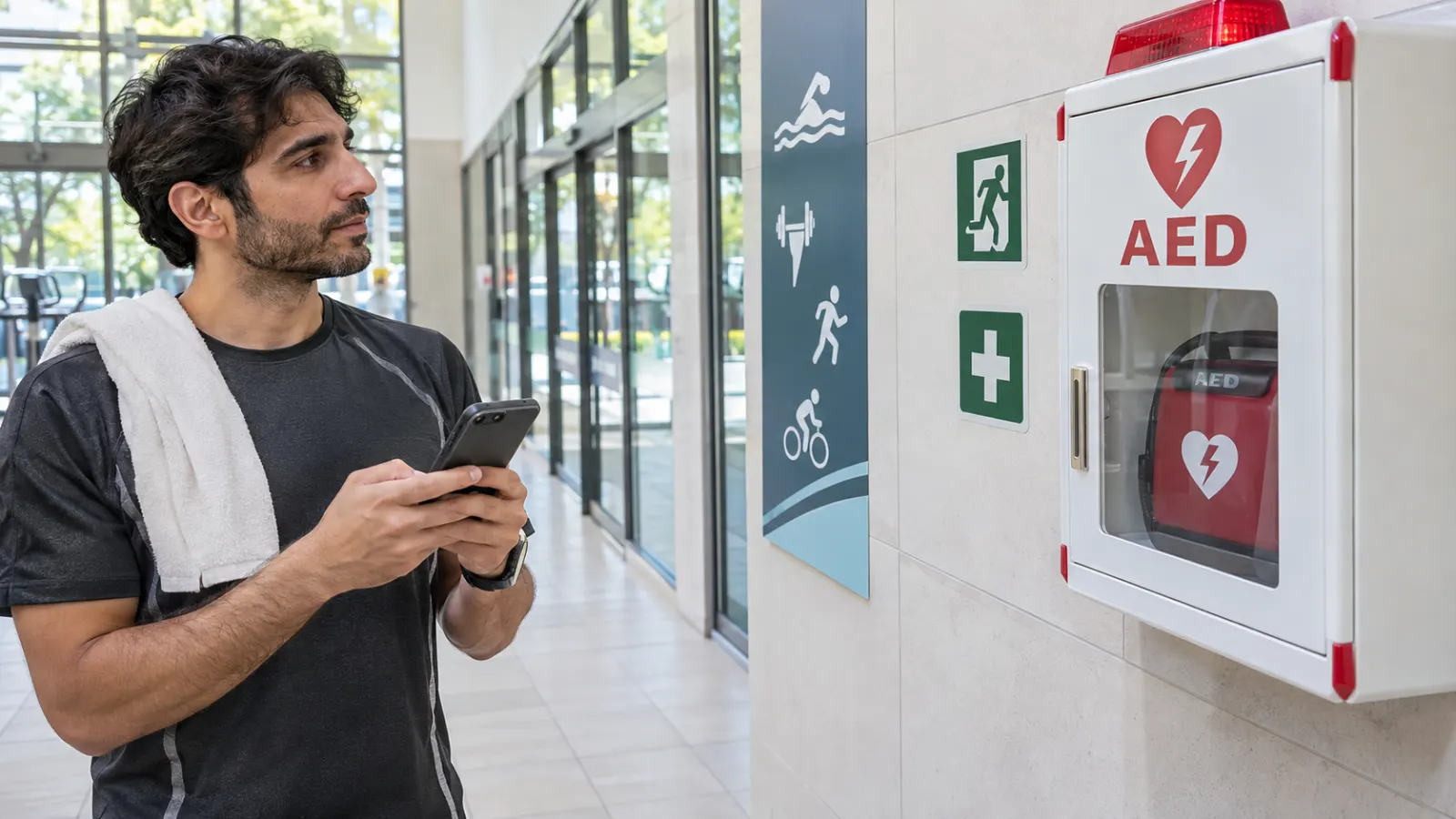
You are in South Korea and want to know where the nearest automated external defibrillator is located. You may have seen an AED sign in a subway station, government building, or sports center, but how can you check its exact location before an emergency?
South Korea provides official AED location information through its emergency medical information system, including the E-Gen portal and government-supported emergency medical information services. The location records can identify the building, address, and installation details of registered devices.
However, a device appearing in a database does not guarantee that it is accessible at every hour or immediately usable.
Here is how to locate an AED and understand what to do if someone needs urgent help.
What Is an AED?
AED stands for Automated External Defibrillator.
In Korean, it is called 자동심장충격기 (jadong simjang chunggyeokgi).
An AED is a medical device designed to analyze certain dangerous heart rhythms and, when appropriate, deliver an electric shock.
It is intended for emergency response to suspected cardiac arrest.
AEDs are installed in various public and private facilities in South Korea.
The presence of an AED does not mean that a building has a medical professional on site.
If someone is unresponsive and not breathing normally, call 119 immediately and follow emergency dispatcher instructions. Do not delay emergency assistance while searching online.
Where Can You Search for an AED?
The National Emergency Medical Center operates the E-Gen emergency medical information service.
Official website:
The Korean name is 응급의료포털 E-Gen.
The service includes information about emergency medical resources, including AED locations.
The Korea Disease Control and Prevention Agency's official emergency information page identifies E-Gen as an official emergency medical information resource.
The government also publishes a nationwide AED location dataset through the Public Data Portal.
How to Look for a Nearby AED
Step 1: Open E-Gen
Visit the official E-Gen website.
Look for the section labeled 자동심장충격기(AED).
The dedicated AED search service is associated with the emergency medical portal.
If the menu or direct page is temporarily unavailable, use the official homepage to navigate to the current service.
Step 2: Search Your Area
Use the available location or regional search options.
For example, you may search near your workplace, apartment complex, university, or hotel.
Korean administrative location names can help narrow the results.
Step 3: Identify the Installation Site
When reviewing an AED location, check details such as:
Building or installation organization
Street address
Specific installation location
Management contact information, where provided
Reported operating or accessible hours, where available
An AED listed at a large building may be located near a security desk, reception area, or another specific section.
Knowing only the building name may not be enough.
Step 4: Check Accessibility
A building may be closed at night even when the AED is registered in the national system.
For example, a device inside an office building may not be accessible to the public after the building closes.
The official nationwide AED dataset warns that reported operating hours and location information may differ from actual conditions.
Check accessibility rather than treating a map marker as a guarantee.
Step 5: Record Useful Locations
It can be helpful to identify AEDs near locations you visit regularly.
For example:
Home or apartment building
Workplace
University
Sports center
Community facility
Keep the information updated because installation locations and accessibility can change.
Can You Use a Government AED Database?
Yes.
South Korea's Public Data Portal publishes an official nationwide AED information service.
The National AED Standard Data page identifies the National Medical Center as the providing institution.
The official dataset covers AED installation information and related administrative details.
According to its service description, available data can include:
Data field | What it means |
|---|---|
Installation organization | The facility responsible for the AED |
Installation address | The location associated with the device |
Installation details | Where the AED is placed |
Management organization | The responsible institution |
Operating hours | Reported hours associated with access or operation |
The Public Data Portal primarily serves as a government data resource and API service.
It is not necessarily the most convenient tool for someone responding to an immediate medical emergency.
For ordinary users, the E-Gen portal or the official emergency medical information application may be more practical.
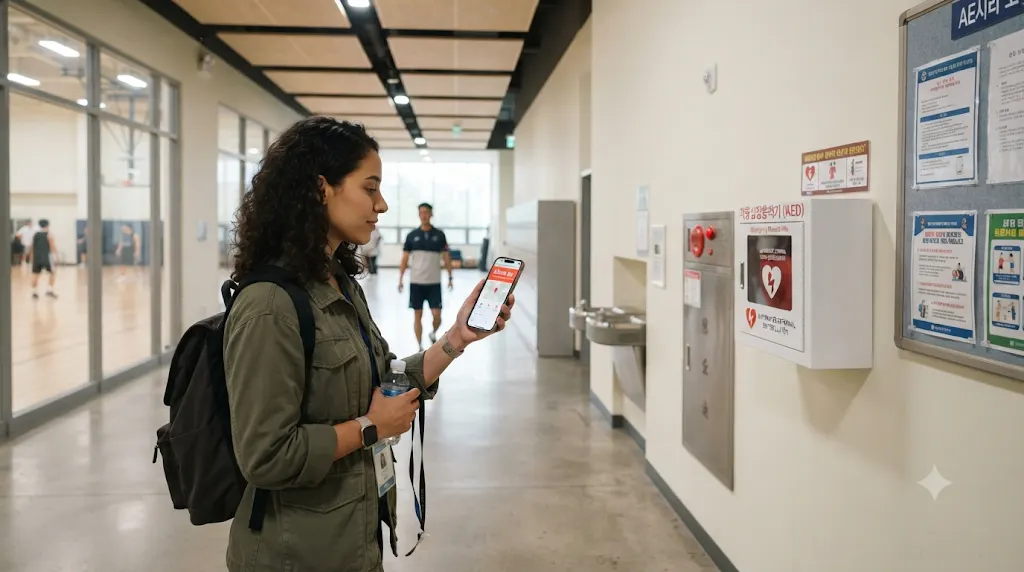
Is There a Mobile App?
Government and public health authorities also identify an emergency medical information application called 응급의료정보제공.
Local public health authorities, including Gijang Public Health Center, explain that the service provides information about nearby emergency rooms, hospitals, pharmacies, and AEDs.
See the official Gijang Public Health Center information page.
Before installing an app, confirm that it is published through the relevant official government channel.
Do not assume that an unrelated application using a similar name provides the same official information.
What If You Cannot Find the Device?
An AED location may be difficult to access for several reasons.
The building may have multiple entrances, the installation point may not be obvious, or staff may have moved equipment within the facility.
Ask building security or staff if they can direct you to the AED.
Do not assume that a device has been removed simply because you cannot immediately see it.
However, if someone is experiencing suspected cardiac arrest, do not spend critical time conducting an extended search without contacting 119 and following emergency instructions.
What Should You Do During a Suspected Cardiac Arrest?
If someone collapses and is unresponsive, seek emergency help immediately.
Call 119 or direct another person to do so.
The emergency dispatcher can provide instructions appropriate to the situation.
If an AED is available, bring it to the person and follow its spoken and visual instructions.
Do not assume that an AED will always deliver a shock. The device analyzes the situation and determines whether a shock is advised.
People assisting should follow the device's safety instructions and the emergency dispatcher's guidance.
If trained in CPR, follow the applicable emergency response procedures.
Searching for a device must not delay calling emergency services or other urgent lifesaving measures.
How Is AED Location Information Maintained?
The official Public Data Portal explains that AED installation information is associated with public health and local government management systems.
Its nationwide service was listed as updated on July 15, 2026.
However, an updated government data service does not mean that every individual installation record has been physically verified at the moment you search.
Information can become outdated when facilities move, close, or change operating hours.
This is why confirming the actual installation location and accessibility is important.
Useful Korean Terms
Korean | English |
|---|---|
자동심장충격기 | Automated external defibrillator |
자동제세동기 | Another term for AED |
설치장소 | Installation location |
설치기관 | Installation organization |
운영시간 | Operating hours |
응급의료 | Emergency medical care |
심폐소생술 | Cardiopulmonary resuscitation |
119 신고 | Call 119 |
These terms can help when searching a Korean-language emergency information service or asking staff for assistance.
Common Mistakes to Avoid
Assuming Every Registered AED Is Available 24 Hours
Actual building access may be restricted.
Relying Only on the Building Address
The device may be installed at a specific location inside the building.
Assuming Location Data Is Always Current
Installation information and operating hours may change.
Delaying an Emergency Call to Search for an AED
Contact 119 immediately when someone needs urgent emergency assistance.
Assuming the AED Will Always Deliver a Shock
The device analyzes the heart rhythm and determines whether a shock is indicated.
Prepare Before an Emergency
Identify nearby AED locations at home, work, and other places you regularly visit.
Check where each device is installed and whether it is accessible during the hours you are normally there.
Learn how to contact emergency services in South Korea.
If possible, take recognized first-aid and CPR training so you can respond more confidently in an emergency.
The location information services and official data descriptions in this article were checked against government and emergency medical institution resources on November 23, 2026.
Quick Summary
South Korea provides AED location information through E-Gen and official emergency medical data services.
Location records can include the installation address, facility, and reported operating information.
A registered AED may not be accessible at every hour, so confirm the actual location when possible.
The emergency medical information application also provides nearby AED information.
For suspected cardiac arrest, call 119 immediately and follow emergency dispatcher and AED instructions.