Bringing Prescription Medication to Korea: What Travelers Should Check Before Flying
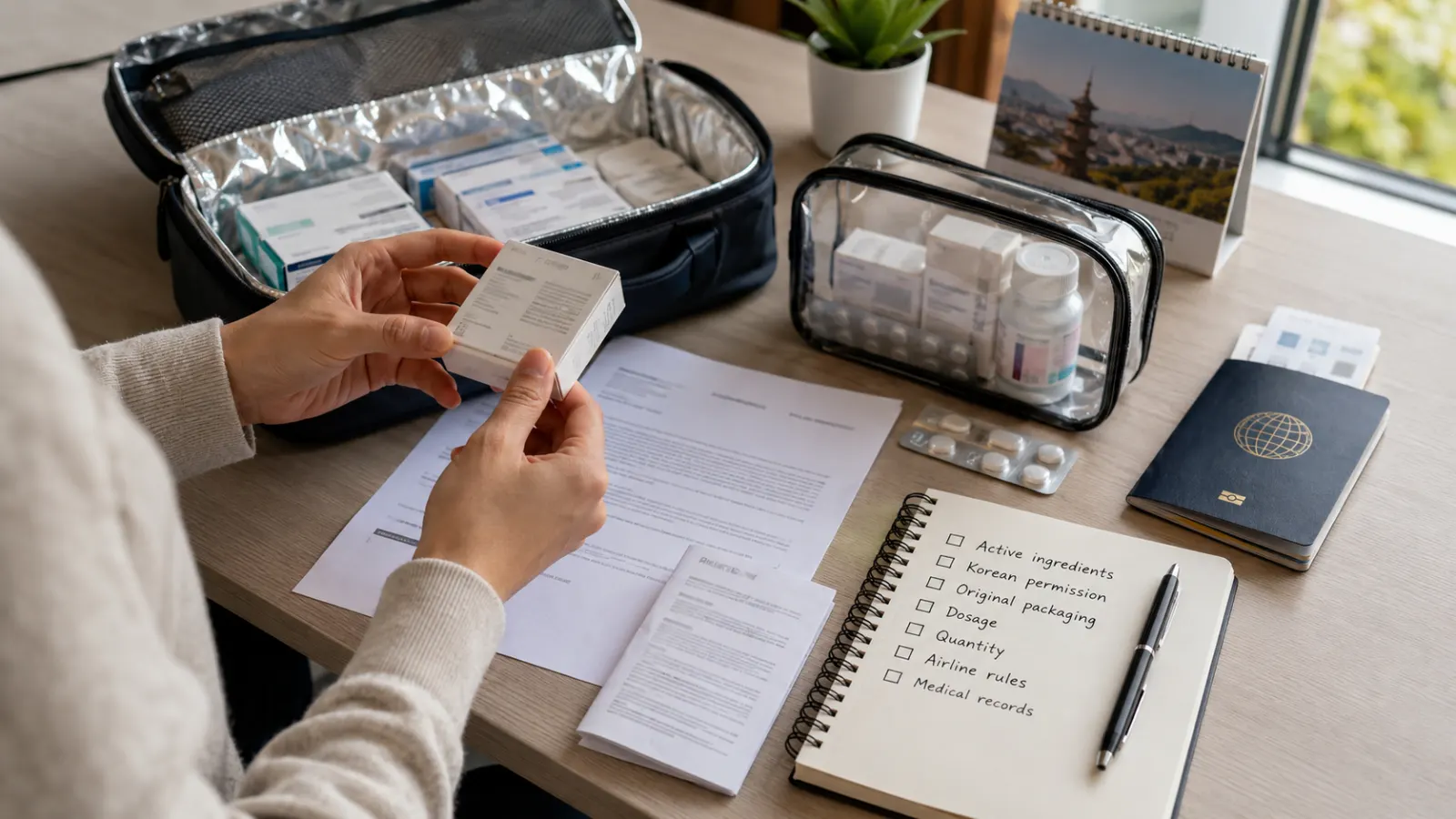
Packing medicine for a trip to Korea can be more complicated than packing clothes or toiletries. A medication that is routinely prescribed in one country may be controlled, restricted, unavailable, or sold under a different name in Korea. Travelers can also face questions when carrying injections, large quantities, sleeping medication, stimulants, pain medicine, or products containing narcotic or psychotropic ingredients.
The safest approach is to identify every active ingredient, check Korean import requirements before departure, carry supporting documents, and keep medicine in its original packaging.
Brand names are not enough
A medicine may be sold under different brand names in different countries. Korean authorities, pharmacists, and doctors need to know the active ingredient. Before traveling, create a list showing:
- Brand name
- Active ingredient
- Strength
- Dose
- Medical purpose
- Prescribing doctor
- Quantity carried
- Travel dates
- Storage requirements
Do not describe a medicine only as “my anxiety pills,” “ADHD medicine,” or “strong painkillers.” Those descriptions are too vague to determine whether a restriction applies. Combination cold medicine, sleep aids, herbal products, and weight-loss products can contain ingredients travelers do not expect. Check the complete ingredient list.
Controlled medicines need special attention
Some narcotic and psychotropic medicines may require advance permission before entering Korea for personal treatment. This can include certain medicines used for:
- Attention disorders
- Severe pain
- Sleep
- Anxiety
- Seizure conditions
- Weight management
- Cough suppression
- Hormonal or psychiatric treatment
The drug’s legal status depends on the ingredient, not on whether it was legally prescribed in your home country.
A doctor’s letter alone may not replace a Korean advance-permission requirement. Travelers should contact the appropriate Korean authority before departure when a controlled ingredient may be involved.
Do not wait until airport arrival to ask whether approval was necessary.
Carry a doctor’s letter
A useful medical letter should ideally include:
- Patient’s legal name
- Date of birth
- Diagnosis or medical necessity
- Generic medication name
- Strength
- Dosage
- Total quantity
- Treatment period
- Prescriber’s name
- Medical facility
- Contact details
- Signature and date
The name should match the passport.
An English letter is more useful than a document written only in a language that Korean officials cannot readily review. A translation may be helpful when the original is not in English or Korean.
Do not alter or create the letter yourself. Ask the prescribing professional to prepare it.
Keep medicine in original packaging
Loose tablets in an unmarked container are difficult to identify. Carry medicine in the pharmacy or manufacturer packaging showing the patient, product, strength, and directions when available. Keep the prescription label attached. For daily organization, you may normally use a pill box at home. For international travel, the original labeled package provides clearer evidence.
Bring only a reasonable quantity connected to the travel period unless you have confirmed that a larger supply is permitted.
Hand luggage or checked baggage?
Essential medicine should generally remain accessible during travel. Checked luggage can be delayed, lost, exposed to temperature changes, or unavailable during a long connection. Keep important medication, documents, and a small treatment supply in cabin baggage, subject to airline and security rules. Special planning may be needed for:
- Refrigerated medication
- Injectable medicine
- Needles and syringes
- Liquid medicine
- Medical devices
- Battery-powered equipment
- Controlled substances
Contact the airline regarding cabin restrictions and cooling arrangements. Do not place medicine directly against frozen packs when freezing could damage it.
Customs declaration
Travelers must declare items when required by Korean customs rules.
Do not hide medication or provide a false description because you are worried it may be delayed. Failure to declare a restricted item can create a more serious problem than asking in advance.
Keep approval documents easy to access at arrival. Do not place the only copy inside checked luggage. When uncertain, use the official customs inquiry channel before travel and retain the written response.
Supplements and herbal products
A product being sold without prescription in another country does not guarantee unrestricted entry into Korea. Supplements may contain:
- Concentrated stimulants
- Hormonal ingredients
- Animal products
- Plant material
- CBD or cannabis-derived substances
- Weight-loss ingredients
- High-dose pharmaceutical compounds
- Undeclared prescription drugs
Labels such as “natural,” “wellness,” or “herbal” do not determine customs status.
CBD and cannabis-related products deserve particular caution because legal treatment differs significantly between countries. Do not carry them based on assumptions from your home jurisdiction.
Replacing medication in Korea
Do not assume that the same product can be purchased after arrival. A Korean doctor may need to evaluate you before issuing a prescription. The available brand, strength, formulation, or controlled-drug rules may differ. Before a long stay:
- Identify the generic ingredient.
- Check whether it is available in Korea.
- Locate an appropriate clinic.
- Bring medical history.
- Bring recent test results.
- Ask the home doctor about alternatives.
- Check insurance coverage.
- Plan enough time before the supply runs out.
A Korean pharmacy usually cannot dispense a prescription-only drug using only an overseas medicine box or informal note.
ADHD and psychiatric medication
Travelers using stimulants, sedatives, sleep medication, anti-anxiety medicine, or other psychiatric drugs should verify requirements carefully. Online advice is often unreliable because two products used for the same condition can contain different ingredients and fall under different rules. Ask the Korean authority using the exact generic name, dosage, and quantity.
For a long-term move, discuss continuity of care with both the current prescriber and a Korean medical provider. Abruptly stopping some medicines can be unsafe.
Pain medication
Strong pain medicine can contain controlled opioid ingredients even when issued after surgery or for chronic pain. The quantity, ingredient, formulation, and treatment purpose may affect import requirements. Carry the prescription, medical letter, and any Korean permission required. Avoid repacking the medicine with ordinary pain relievers.
If treatment may continue in Korea, contact an appropriate hospital before the remaining supply becomes low.
Travel insurance and medical records
Travel insurance may not cover a predictable need to replace medicine that was confiscated, packed incorrectly, or brought without required approval. Review the policy before departure. Keep digital copies of:
- Prescription
- Doctor’s letter
- Approval
- Passport
- Medicine list
- Insurance certificate
- Prescriber contact
- Emergency medical summary
Protect these documents with secure storage rather than leaving sensitive medical information open on a shared device.
What to do before flying
Use this checklist:
- Check every active ingredient
- Confirm whether any ingredient is controlled
- Apply for Korean permission when required
- Request a doctor’s letter
- Keep original packaging
- Carry a reasonable quantity
- Check airline liquid and needle rules
- Plan temperature control
- Store documents in cabin baggage
- Identify a Korean care option for long stays
Medication rules can change, and a past successful trip does not guarantee that the same product can be brought again without checking.
Quick Summary
- Check prescription medicines by active ingredient, not only brand name.
- Certain narcotic or psychotropic medicines may require advance Korean permission.
- Carry original packaging, a prescription, and a detailed doctor’s letter.
- Long-term visitors should plan how prescriptions will be continued through a Korean medical provider.