Health
How Chronic Disease Management Works in Korea for Foreign Patients
By New In Korea TeamPublished Updated

If you're managing a chronic condition, diabetes, hypertension, thyroid disease, or another ongoing health concern, and moved to Korea either recently or are trying to transition your care from a previous provider abroad, understanding how Korea's healthcare system approaches long-term chronic disease management, and what specifically changes about your care routine, helps you maintain continuity rather than experiencing gaps or confusion during the transition.
Here's how chronic disease management actually works in Korea for foreign patients.
Establishing Care With a Korean Provider
- Bringing comprehensive documentation of your condition and treatment history from your previous provider, translated if possible, including diagnosis details, current medication regimen, and any recent relevant test results, significantly streamlines your first appointment with a new Korean provider compared to starting the diagnostic process from scratch.
- Internal medicine specialists generally manage common chronic conditions like hypertension, diabetes, and thyroid disorders as covered in how to find a primary care doctor in Korea, establishing an ongoing relationship with a specific internal medicine doctor tends to work well for coordinated, consistent chronic condition management.
- More complex or less common chronic conditions may warrant a specific specialist, endocrinology for complex diabetes management, cardiology for certain heart conditions, understanding whether your specific condition's complexity warrants a specialist relationship beyond general internal medicine matters for appropriate care routing.
Medication Continuity and Local Equivalents
- Korean doctors will generally prescribe a locally available equivalent medication rather than continuing to import your specific home-country brand indefinitely, as touched on in how prescription refills work in Korea, bringing the generic or active ingredient name, rather than relying solely on a home-country brand name, helps identify the correct local equivalent efficiently.
- Dosage and formulation differences sometimes exist between countries for what's otherwise the same active medication, a thorough conversation with your new Korean provider about your current dosage and any specific formulation considerations helps ensure an accurate transition rather than assuming automatic equivalence.
- Regular follow-up visits for prescription renewal, generally more frequent than some auto-refill systems in other countries, as covered in the broader prescription renewal process, apply the same way to chronic condition medication specifically, planning around this renewal cadence matters for maintaining consistent treatment.
What National Health Insurance Covers for Chronic Care
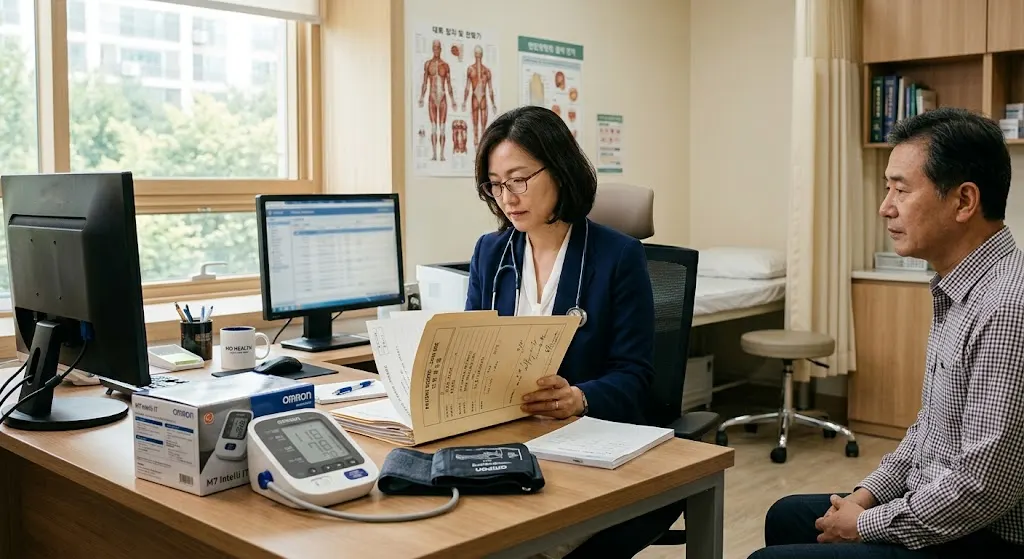
- Regular monitoring visits and associated testing, blood work for diabetes management, blood pressure monitoring for hypertension, and similar routine chronic condition monitoring, are generally covered under standard NHI partial copay structures.
- Long-term medication costs, generally covered at a reduced copay similar to other prescription medication, though specific newer or specialized treatments may have different coverage levels worth confirming with your specific provider and pharmacy.
- Specialist consultations, if your specific condition warrants ongoing specialist rather than general internal medicine management, generally follow standard NHI coverage patterns for specialist visits.
Practical Steps for a Smooth Transition
- Gather and translate your complete medical history before your first Korean appointment, diagnosis documentation, current medication list with dosages, recent relevant test results, and any specific treatment plan notes from your previous provider.
- Establish care with a specific provider promptly after arriving in Korea, rather than delaying until symptoms become urgent, particularly important for conditions requiring consistent medication access and regular monitoring.
- Understand your specific condition's monitoring schedule in the Korean system, confirming how frequently follow-up visits and testing are expected, since this cadence sometimes differs somewhat from what you were used to previously.
- Register for National Health Insurance promptly if eligible, as covered in how NHI works for foreigners, ensuring your chronic condition care is appropriately subsidized from the earliest possible point rather than facing full out-of-pocket costs during a coverage gap.
Common Mistakes Foreign Patients Make
- Not bringing sufficient documentation of prior diagnosis and treatment, forcing a new Korean provider to essentially restart the diagnostic and treatment-establishment process rather than efficiently continuing established care.
- Running out of medication before establishing local care, particularly risky for conditions where medication interruption has meaningful health consequences, planning your transition timeline to avoid any gap in treatment continuity matters significantly.
- Assuming identical medication brands or exact dosage forms will be available, rather than understanding that a local equivalent, possibly requiring some initial adjustment period, is the realistic expectation.
- Delaying NHI enrollment, facing unnecessary full out-of-pocket costs for chronic condition management during a coverage gap that proper, timely enrollment would have avoided.
Quick Summary
- Bringing comprehensive, translated documentation of your chronic condition and treatment history significantly streamlines establishing care with a new Korean provider compared to starting from scratch.
- Internal medicine specialists generally manage common chronic conditions, while more complex cases may warrant a specific specialist relationship, understanding your condition's appropriate care routing matters for effective management.
- Korean doctors generally prescribe local medication equivalents rather than continuing home-country brands indefinitely, bringing generic or active ingredient names helps ensure accurate identification of the correct local equivalent.
- Establishing care and NHI enrollment promptly after arrival, rather than delaying, helps avoid treatment gaps and unnecessary out-of-pocket costs during your transition to Korean healthcare.